
An outsourced ops team — in the e-commerce context — is a structured group of offshore specialists, typically based in the Philippines, who own defined operational functions end-to-end. They are not a call center vendor. They are embedded team members with role-specific access, documented decision rights, and escalation protocols that allow them to resolve the majority of operational volume without founder involvement. The distinction matters: a vendor takes tickets; an embedded ops team takes ownership.
Anonymized composite case studies based on engagements with e-commerce operators across DTC, Amazon FBA, and multi-channel brands. No real named-firm incidents are depicted.

The Structural Problem: You Are the Bottleneck
Every decision routes through you. Every customer escalation lands in your inbox. Every inventory discrepancy waits for your approval before anyone acts. This is the “founder-as-hub” anti-pattern — and it is the primary structural cause of operational stagnation in sub-$10M e-commerce businesses.
It is not a time management problem. It is an architecture problem.
The four operational categories that consume founder time most disproportionately to their revenue impact are order management, customer service, inventory reconciliation, and returns processing. These are high-volume, repetitive, SOP-driven functions. None of them require a founder’s judgment. All of them can be systematized, delegated, and run offshore — if the build sequence is executed correctly.
The Four Operational Bottlenecks — and Why They Are Offshore-Ready
Customer Service (Chat, Email, Phone)
Customer service is the highest-volume, most time-consuming operational function for most e-commerce brands. It is also the most systematizable. The majority of inbound tickets — order status inquiries, return requests, sizing questions, shipping delays — follow predictable patterns that can be documented in a response library and handled by a trained Tier 1 agent without founder involvement.
The ceiling: A well-trained offshore customer service specialist, operating with a documented escalation framework, can autonomously resolve an estimated 65–80% of inbound ticket volume. The founder’s touchpoints compress dramatically.
The floor: The first 60–90 days carry real friction. Response quality depends entirely on the quality of the SOP documentation the founder provides before the hire begins. Founders who skip the documentation sprint and expect the offshore hire to “figure it out” consistently experience a longer ramp, higher error rates, and early churn.
Order Management and Fulfillment Coordination
Order processing — pulling orders, coordinating with 3PLs, flagging exceptions, updating customers on delays — is a high-frequency, low-judgment function. It is also one of the easiest to delegate once platform access is configured correctly.
Shopify, WooCommerce, and Amazon Seller Central all support role-based access controls. Founders can grant offshore team members access limited to exactly the operational functions they need — order views, fulfillment status, customer communication — without exposing financial data, pricing configurations, or account-level settings. This is a key risk mitigation practice, not an afterthought.
Inventory Reconciliation
Inventory discrepancies are a silent margin killer. Phantom stock, FBA shipment variances, and multi-warehouse reconciliation errors accumulate quietly until they surface as a stockout, an oversell, or an accounting problem. These tasks are data-intensive and repetitive — exactly the profile that suits an offshore specialist with platform experience.
Amazon FBA sellers, in particular, are increasingly using trained offshore marketplace specialists to manage FBA shipment reconciliation, listing suppression resolution, and A+ content updates. These are platform-specific skills that Philippine-based specialists are accumulating through direct experience and, in some cases, platform-specific certifications.
Returns Processing
In apparel e-commerce, return rates can reach an estimated 20–30% of gross orders. That volume of returns — each requiring customer communication, refund or exchange processing, and inventory updates — is a significant operational load. It is also almost entirely SOP-driven.
Returns processing is one of the clearest cases for offshore delegation. The decision logic is finite: does the return meet policy criteria? If yes, process. If no, escalate. A well-documented returns SOP converts what feels like a judgment-intensive function into a structured workflow that an offshore specialist can own.
Data Privacy Compliance: The Non-Negotiable Layer
E-commerce operations involve personal data: customer names, shipping addresses, order histories, and payment metadata. When that data is handled by an offshore team in the Philippines, it crosses an organizational boundary — and that triggers formal compliance obligations under Philippine law.
The Data Privacy Act of 2012 (Republic Act 10173), enforced by the National Privacy Commission (NPC), governs how personal data is collected, processed, and shared. When a foreign e-commerce brand (the Personal Information Controller, or PIC) shares customer data with a Philippine-based offshore team or staffing partner (the Personal Information Processor, or PIP), the NPC requires a formal Data Processing Agreement (DPA) between the two parties.
Practical compliance steps for e-commerce founders:
- Execute a Data Processing Agreement with your Philippine staffing partner or direct-hire team before granting data access.
- Configure role-based access controls on Shopify, Amazon Seller Central, or WooCommerce to limit offshore team exposure to only the data required for their function.
- Ensure your offshore team members are briefed on data handling protocols — what data they can access, how it must be stored, and what constitutes a reportable incident.
- Review your own privacy policy to confirm it accurately reflects that customer data may be processed by offshore partners.
Founders who treat data compliance as a post-launch cleanup item create legal exposure for themselves and their customers. It is a pre-launch configuration task.

How It Works
The Build Sequence: Systems Before Staff
The most common failure mode in offshore ops team builds is hiring before documenting. A founder hires an offshore specialist, hands them a login and a Slack invite, and expects operational relief within two weeks. What they get instead is a confused new hire, a frustrated founder, and a failed engagement.
The correct sequence is:
Offshore Ops Team Build Sequence
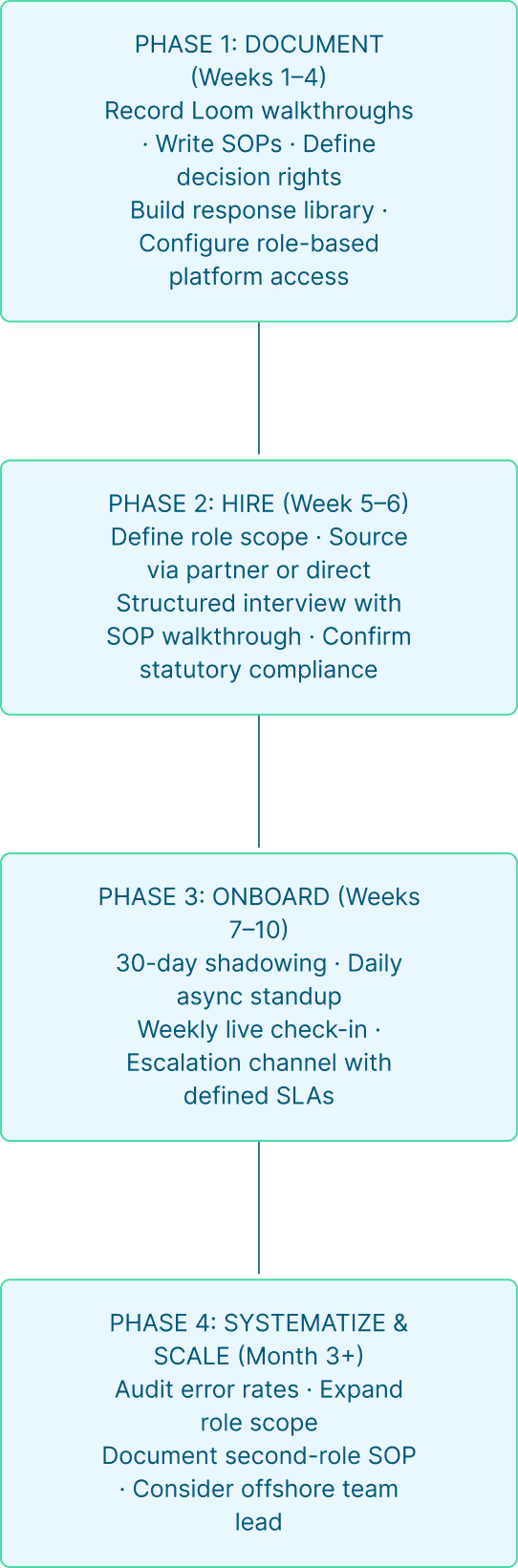
The first hire is always the highest-friction step. Once the operating model is documented and the first hire is performing, subsequent hires scale more efficiently. The SOP library compounds. The onboarding time for hire two is materially shorter than for hire one.
Tiered Escalation: The Framework That Removes the Founder from Day-to-Day
The tiered escalation framework is the structural mechanism that allows an offshore ops team to function without the founder as a constant decision node.
| Tier | Who Handles | Examples | Founder Involvement |
| Tier 1 | Offshore team, autonomous | Order status, standard returns, shipping delay updates, listing data entry | None |
| Tier 2 | Offshore drafts, founder reviews | Non-standard refund requests, customer complaints above threshold, listing suppression | Async review (< 5 min) |
| Tier 3 | Founder only | Policy changes, high-value customer disputes, media/PR escalations | Full involvement |
In practice, a well-documented Tier 1 framework handles an estimated 65–80% of inbound volume autonomously. Tier 2 requires founder input but compresses it to an async review — a Slack message or email approval — rather than a live conversation. Tier 3 events are rare by design.
The founder’s operational touchpoints do not disappear. They compress and become intentional.
Phase Risk Analysis: Where Offshore Ops Builds Fail
| Phase | Common Failure Mode | Root Cause | Mitigation |
| Pre-hire | Hiring before SOPs exist | Founder impatience | Enforce 30-day documentation sprint as a hard prerequisite |
| Onboarding (Days 1–30) | Offshore hire left to self-direct | No structured ramp plan | Implement shadowing protocol with daily async check-ins |
| Onboarding (Days 31–60) | Quality issues surface, founder re-absorbs tasks | No feedback loop | Weekly live review sessions; error log with structured debrief |
| Month 3–6 | Offshore hire disengages, attrition risk rises | No career visibility, no recognition | Introduce progression framework; monthly 1:1s |
| Scaling (Hire 2+) | Second hire onboards poorly | SOP library not updated after Hire 1 | Treat SOP documentation as a living system, not a one-time event |
| Ongoing | Founder re-centralizes decisions during growth spurts | Stress reverts to “founder-as-hub” pattern | RACI or decision-rights document reviewed quarterly |
The RACI review is the most commonly skipped maintenance task. As the business grows and new operational functions emerge, decision rights drift back toward the founder by default unless the framework is actively maintained.
Churn Risk and Retention: The Hidden Variable
Offshore team churn is the most underestimated risk in this model. Founders who treat offshore staff as interchangeable transactional resources — low engagement, no feedback, no career visibility — experience attrition that erases the efficiency gains they built.
The structural distinction that matters is between staff augmentation (offshore staff are embedded team members with career paths and consistent feedback loops) and pure outsourcing (a vendor delivers outputs with no team-level relationship). The former produces meaningfully lower churn.
Practical retention levers:
- Clear career progression: Even a two-tier structure (specialist → senior specialist → team lead) signals that tenure is valued.
- Consistent feedback cadence: Monthly one-on-ones, not just annual reviews.
- Inclusion in team communications: Offshore staff who receive the same company updates as onshore staff generally demonstrate higher engagement — a pattern consistently observed across embedded offshore team engagements.
- Recognition: Public acknowledgment of strong performance in team channels costs nothing and compounds over time.
Churn in the first year of an offshore engagement is the most expensive failure mode — not because of severance, but because of the re-onboarding cost and the SOP knowledge that walks out the door.

Key Benefits
Operational Hours Compress Dramatically
Founders who execute the build sequence correctly — document first, hire second, systematize third — compress their operational hours by an estimated 50–75% and redirect that capacity toward the strategic functions that actually scale a business.
The Founder Shifts from Operator to Owner
The mature end-state of this model is the founder as strategist, not operator. A senior offshore ops manager can run daily async standups, handle quality review of the team’s output, and escalate only genuine judgment calls to the founder — removing the founder from day-to-day team coordination entirely.
SOP Documentation Compounds Over Time
The SOP library built for hire one shortens onboarding for every subsequent hire. The operational knowledge that previously lived only in the founder’s head becomes a durable, transferable organizational asset.
Embedded Team Dynamics Drive Retention
Unlike a BPO vendor relationship, the staff augmentation model creates genuine team identity. Offshore specialists who are included in company communications, given career progression visibility, and recognized for strong performance stay longer — protecting the SOP investment and reducing re-onboarding costs.
Platform Access Controls Contain Risk
Role-based access controls on Shopify, Amazon Seller Central, and WooCommerce allow founders to grant offshore team members exactly the permissions they need — and nothing more. Financial data, pricing configurations, and account-level settings remain protected. This is a structural risk mitigation, not a workaround.
Statutory Compliance Is Manageable
Philippine labor law’s statutory obligations (SSS, PhilHealth, Pag-IBIG) are well-defined and predictable. A managed staffing partner bundles these into the all-in rate, removing administrative burden from the founder. For direct hires, the obligations are finite and calculable — approximately 12–15% above base salary in employer-side contributions.
Costs & Pricing
All-In Hourly Rates (Illustrative Ranges)
All figures below are illustrative estimated ranges. Actual rates vary by engagement model (staff augmentation vs. direct hire), seniority, and scope. Figures are inclusive of an employer-side statutory load estimate.
| Role | Complexity | Estimated All-In Rate |
| Customer Service Specialist (Tier 1) | Entry–Mid | $6–$9/hr |
| Order Management / Marketplace Specialist | Mid | $8–$11/hr |
| Inventory Reconciliation Specialist | Mid | $8–$11/hr |
| Returns Processing Specialist | Entry–Mid | $6–$9/hr |
| Virtual Operations Manager (Pod Lead) | Senior | $11–$14/hr |
The Statutory Load Reality for Direct Hires
If you hire Philippine-based staff directly (rather than through a managed staffing partner), Philippine labor law mandates employer-side contributions to three statutory programs:
- SSS (Social Security System)
- PhilHealth (national health insurance)
- Pag-IBIG (housing fund)
These contributions collectively add approximately 12–15% above base salary in employer-side statutory costs. This is a hard legal obligation — not optional, not negotiable. Founders who budget only for base salary and discover the statutory load mid-engagement face a compliance gap and a cost surprise simultaneously.
Staff augmentation models typically bundle statutory compliance into the all-in rate, removing this administrative burden from the founder. The trade-off is a slightly higher per-hour cost in exchange for compliance certainty and reduced administrative overhead.
When Does the Model Become Financially Justified?
The inflection point is less about revenue and more about operational volume and founder time cost. When a founder is spending more than 15–20 hours per week on Tier 1 and Tier 2 operational tasks, the opportunity cost of that time — measured against what the founder could be doing strategically — typically exceeds the all-in cost of a single offshore hire within the first quarter. For most e-commerce brands, this threshold appears somewhere in the $1.5M–$3M annual revenue range (illustrative), though high-SKU or high-return-rate businesses can hit it earlier.
Global Case Studies
Anonymized composite case studies based on engagements with e-commerce operators across DTC, Amazon FBA, and multi-channel brands. No real named-firm incidents are depicted.
Case Study A: The Two-Person Ops Pod (DTC Apparel, Sub-$5M)
A US-based direct-to-consumer apparel brand with sub-$5M in annual revenue was run by a founder who was spending an estimated 25–30 hours per week on operational tasks — customer emails, return processing, inventory spot-checks, and marketplace listing updates. Product development and brand strategy were being crowded out.
The founder ran a 30-day SOP documentation sprint before hiring. Two Philippine-based offshore specialists were brought on: one owning customer service and returns, one owning inventory reconciliation and marketplace listing management. Within 90 days, the founder’s operational hours had compressed to an estimated 6–8 hours per week. The remaining time was redirected to supplier relationships and a new product line launch.
The primary unlock was not the hiring. It was the SOP documentation sprint that preceded it.
Case Study B: The Tiered Escalation Unlock (Home Goods, $3–8M)
A Shopify-native home goods brand built a three-person offshore ops pod: a customer service lead, an order management specialist, and a part-time bookkeeping assistant. The brand’s prior model had the founder reviewing every customer ticket before a response was sent.
After implementing a tiered escalation policy — with a documented Tier 1 response library covering the top 25 ticket types — the offshore team was resolving an estimated 70–80% of tickets autonomously within 60 days. The founder’s involvement in customer service compressed from daily to a weekly quality-review pass.
The bookkeeping assistant, working part-time, handled accounts payable data entry and reconciliation — a function the founder had been doing personally on weekends.
Case Study C: The Amazon FBA Marketplace Specialist (Single-to-Multi-SKU Expansion)
An Amazon FBA seller scaling from one to four product lines used a Philippine-based offshore marketplace specialist to manage listing health, suppression resolution, and FBA shipment reconciliation. The specialist held accumulated platform experience across multiple seller accounts from prior BPO work.
The founder’s time, previously split between sourcing and operational firefighting, was redirected almost entirely to supplier negotiations and product launch sequencing. The offshore specialist owned the operational layer of the Amazon account. The founder owned the strategic layer.
Case Study D: The Senior Offshore Ops Manager (Beauty Brand, Multi-Channel)
A founder-led beauty brand hired a senior Philippine-based virtual operations manager — a professional with prior BPO team lead experience — to manage a small offshore pod. The ops manager ran daily async standups, handled quality review of the team’s output, and escalated only genuine judgment calls to the founder.
The founder was removed from day-to-day team coordination entirely. The ops manager became the operational center of gravity. The founder’s role shifted to brand partnerships, retail expansion conversations, and product development.
This is the mature end-state of the model: the founder as strategist, not operator.
Philippines Relevance & Local Examples
Why the Philippines Is the Dominant Talent Pool for This Model
The Philippines is not simply a low-cost labor market. It is a structurally mature offshore staffing ecosystem with institutional depth that most other markets cannot replicate at scale.
The country’s IT-BPO sector employs over 1.4 million full-time equivalents (illustrative figure) — one of the largest concentrations of English-proficient, process-trained knowledge workers in the world. The Philippines produces approximately 500,000 college graduates annually (illustrative) across business administration, communications, IT, and related disciplines. The pipeline is not thinning.
English Proficiency as a Structural Advantage
English proficiency is a structural advantage, not a marketing claim. The Philippines consistently ranks among the highest-proficiency non-native English-speaking countries in the Asia-Pacific region on independent proficiency indices — a function of the country’s educational system, which uses English as a primary medium of instruction.
Time-Zone Workability
The time-zone reality is more workable than most founders assume. The Philippines operates at UTC+8. US West Coast business hours (UTC-7/8) produce a 2–4 hour real-time overlap during standard business hours. Many experienced offshore professionals in the BPO sector are accustomed to shifted schedules and will work US-aligned hours for a modest premium — making synchronous coverage achievable without heroic scheduling gymnastics.
Sector Depth and Government Investment
The IT-BPO sector has historically contributed an estimated 7–9% of Philippine GDP (illustrative), signaling that this is not a cottage industry. It is a core economic pillar with government-level investment in workforce development, infrastructure, and regulatory frameworks.
Platform-Specific Skill Accumulation
Amazon FBA sellers, in particular, are increasingly using trained offshore marketplace specialists based in the Philippines to manage FBA shipment reconciliation, listing suppression resolution, and A+ content updates. These are platform-specific skills that Philippine-based specialists are accumulating through direct experience and, in some cases, platform-specific certifications — making the talent pool increasingly specialized, not just generically available.
Statutory Compliance Framework (Philippine Labor Law)
Philippine labor law mandates employer-side contributions to three statutory programs for direct hires:
- SSS (Social Security System)
- PhilHealth (national health insurance)
- Pag-IBIG (housing fund)
These contributions collectively add approximately 12–15% above base salary in employer-side statutory costs. Philippine labor law also mandates overtime pay for hours worked beyond eight hours per day, and night differential pay (typically an additional 10% of hourly rate) for hours worked between 10:00 PM and 6:00 AM Philippine time. Founders building US-hours-aligned schedules must factor night differential into their all-in rate calculations.
Data Privacy Act of 2012
The Data Privacy Act of 2012 (Republic Act 10173), enforced by the National Privacy Commission (NPC), governs how personal data is collected, processed, and shared within and across Philippine organizational boundaries. When a foreign e-commerce brand shares customer data with a Philippine-based offshore team, a formal Data Processing Agreement (DPA) between the Personal Information Controller (PIC) and the Personal Information Processor (PIP) is required before data transfer occurs.
See compliance and service structures guide for the full Philippine statutory and NPC compliance framework.
Comparison Table
Engagement Models for Building Your Offshore Ops Team
The three primary models for engaging Philippine-based offshore ops staff differ significantly across control, compliance burden, cost, and retention dynamics. The table below provides an illustrative comparison; actual terms vary by provider and engagement structure.
| Dimension | Staff Augmentation (via Partner) | Direct Hire (Employer of Record) | Pure Outsourcing (BPO Vendor) |
| Control over team | High | High | Low |
| Statutory compliance burden | Partner-managed | Founder-managed | Vendor-managed |
| Cost per hour | Mid ($8–$14 all-in, illustrative) | Lower base, +12–15% statutory | Variable (often higher for small volumes) |
| Onboarding speed | Moderate | Slower (compliance setup) | Fast |
| Team identity/retention | High (embedded model) | High | Low |
| SOP ownership | Founder retains | Founder retains | Shared or vendor-held |
| Scalability | High | Moderate | High |
| Best for | Founders wanting embedded team without compliance overhead | Founders with HR/legal capacity | High-volume, commodity functions |
Which Model Fits Most Sub-$10M Founders?
For most sub-$10M e-commerce founders, staff augmentation through a managed partner is the lowest-friction entry point. It removes the statutory compliance administration, provides a faster path to a productive hire, and preserves the embedded team dynamic that drives retention. The freelancer model works at low volume but breaks down when operational continuity, team coordination, and SOP ownership become critical — which is why the embedded staff augmentation model outperforms ad-hoc freelancing at scale.
See the Philippines data compliance and onboarding checklist for the pre-hire documentation framework.
Conclusion & Actionable Takeaway
The offshore ops team model works. Evidence from composite engagements across DTC, Amazon FBA, and multi-channel e-commerce brands is consistent: founders who execute the build sequence correctly — document first, hire second, systematize third — compress their operational hours by an estimated 50–75% and redirect that capacity toward the strategic functions that actually scale a business.
The model does not work when founders treat it as a staffing transaction rather than an organizational design decision. The offshore team is not a vendor. It is the operational layer of your business. Build it like one.
Three Immediate Actions for Founders
- Audit your week. Log every operational task you personally touched in the last five business days. Classify each as Tier 1 (SOP-driveable), Tier 2 (judgment-light), or Tier 3 (founder-only). The Tier 1 and Tier 2 tasks are your delegation roadmap.
- Start the documentation sprint. Before you post a job description, record Loom walkthroughs of your top five operational workflows. Convert them to written SOPs. This is the single highest-leverage pre-hire investment you can make.
- Get the compliance layer right before day one. If you are handling customer data offshore, execute a Data Processing Agreement before granting access. Configure role-based permissions on your platforms. This is a one-time setup that protects you permanently.
The founders who build this correctly stop being operators. They become owners.
Explore engagement options at OffshorePH or review the full onboarding framework in the Philippines data compliance and onboarding checklist.
FAQs
Can a Philippine-based offshore ops specialist manage my Amazon Seller Central account without creating account health risks?
Yes — provided you configure secondary user permissions correctly through Amazon’s user permissions system, which allows granular control over what each user can view or edit, and you brief the specialist on Amazon’s communication policies to avoid policy violations from non-compliant buyer messaging. The risk is not the offshore location; it is insufficient permission scoping and inadequate policy briefing before the hire goes live.
What happens to statutory compliance if my offshore hire works shifted hours to cover US business hours — does that trigger overtime obligations under Philippine labor law?
Philippine labor law mandates overtime pay for hours worked beyond eight hours per day, and night differential pay (typically an additional 10% of hourly rate) for hours worked between 10:00 PM and 6:00 AM Philippine time. If a US-hours-aligned schedule pushes your offshore hire into night-differential territory, that cost must be factored into your all-in rate calculation. A managed staffing partner will typically handle this calculation; direct-hire founders must account for it explicitly in their compensation structure.
How should I structure a Data Processing Agreement (DPA) with a Philippine-based staffing partner to satisfy NPC requirements?
The DPA must, at minimum, identify the Personal Information Controller (your e-commerce brand) and the Personal Information Processor (the staffing partner or offshore team entity), specify the categories of personal data being processed, define the permissible processing purposes, establish data security obligations, and include breach notification protocols. The NPC’s advisory guidance on PIC-PIP agreements provides the compliance baseline. Engage a Philippine-licensed attorney or a staffing partner with an established DPA template to ensure the document meets current NPC standards — do not use a generic GDPR data processing agreement template without Philippine-specific adaptation.
At what revenue or order volume does it make financial sense to build a dedicated offshore ops team rather than using a freelancer or a BPO vendor?
Watch your hours, not your revenue line. Once you’re logging more than 15–20 hours a week on Tier 1 and Tier 2 tasks, that time is worth more than what a single offshore hire costs — usually within one quarter of making the switch. In dollar terms, most e-commerce brands hit this point somewhere in the $1.5M–$3M annual revenue range (illustrative), though a high-SKU catalog or a high return rate can pull that threshold earlier. Freelancers can absorb the overflow at low volume, but they aren’t built for the continuity and SOP ownership a growing ops function needs — that’s the gap a dedicated offshore team is designed to close.
Related Services & Next Steps
Explore the links below to move from assessment to action:
- OffshorePH — Overview of OffshorePH’s offshore staffing model for e-commerce operators
- Philippines data compliance and onboarding checklist — The pre-hire SOP documentation framework and 90-day ramp protocol
- Compliance and service structures guide — Philippine statutory obligations, Data Processing Agreement requirements, and NPC compliance guidance for e-commerce brands
