
Outsourced staffing partnerships replace or supplement internal HR functions by transferring payroll administration, benefits coordination, compliance tracking, and talent sourcing to a specialized external provider — typically operating offshore. For growth-stage tech companies, this converts a fixed, headcount-dependent cost center into a variable, scalable operating model. The decision is not primarily about cost arbitrage. It is about velocity.
Growth-stage tech companies face a structural timing problem, not merely an HR problem. Internal HR teams are built for steady-state operations — sized, tooled, and process-designed for a specific headcount band, not for that band plus 80% arriving 14 months later.
When a two-person HR generalist team becomes responsible for onboarding 40 new hires per quarter, managing multi-state compliance, running benefits enrollment, and simultaneously backfilling attrited roles, the function does not bend. It breaks.
Three Failure Modes That Appear Consistently
Three distinct failure modes emerge under hypergrowth pressure.
Compliance gaps accumulate silently. Onboarding documentation falls behind. I-9 verification timelines slip. State-specific payroll tax registrations are delayed. None of these are visible until an audit or a termination dispute surfaces them.
Recruiting quality degrades under volume pressure. When the same HR generalist managing compliance is also sourcing candidates, screening resumes, and scheduling interviews, sourcing quality drops — not because the person is incompetent, but because the role was never designed for that throughput.
Strategic HR work disappears entirely. Culture, performance management, and executive-level people operations — the work that actually compounds organizational value — get deferred indefinitely while the team fights operational fires.
This is the structural reality driving founders toward outsourced staffing partners. Not a preference for outsourcing as a philosophy. A recognition that the in-house model has a hard ceiling at scale velocity.
The Floor: What Cost Comparisons Omit
The savings case for offshore HR support is real — but it is back-weighted. Implementation costs that founders frequently underestimate on the front end include:
- Knowledge transfer investment. An offshore HR-support team cannot operate effectively without documented processes, system access protocols, and a structured onboarding period. Firms that skip this step typically see the first 60–90 days consumed by rework and escalations.
- Management overhead. Someone domestically must own the relationship, handle exception cases, and maintain quality standards. That is not zero cost.
- Year-one attrition risk. Offshore staffing arrangements without deliberate retention infrastructure — career pathing, cultural integration, performance feedback loops — can see meaningful attrition in year one. Poorly structured engagements can experience attrition in the mid-teens to 30%+ range (estimated/illustrative — reflects general offshore staffing dynamics; no single verified external source). Each departure resets the knowledge transfer clock.
- Data security and compliance overhead. Offshore HR functions handle sensitive employee data: compensation records, tax documents, benefits enrollment data, performance records. That data flow requires contractual and technical controls that carry their own setup and maintenance costs.
A venture-backed data analytics firm (anonymized composite) that conducted a rigorous build-vs-buy analysis found the per-seat offshore savings compelling — but also found that the first six months required heavier management attention than projected, and that net savings in year one were closer to 25–30% after accounting for transition costs. By year two, the model performed closer to the 50% savings projection.
Phase Risk Analysis: Where These Transitions Fail
Risk 1: Selecting on price, not retention infrastructure. The cheapest offshore staffing partner is frequently the one with the highest year-one attrition. A 25% attrition rate in an HR-support pod means re-onboarding one in four team members annually — each reset costing 4–8 weeks of productivity (estimated/illustrative). Due diligence on a partner’s retention programs, career development frameworks, and employee satisfaction metrics is not optional.
Risk 2: Inadequate process documentation before handoff. Offshore teams cannot operate on institutional knowledge that lives in a domestic HR manager’s head. If the process documentation phase is compressed or skipped, the offshore team will generate escalations at a rate that consumes the domestic team’s time — eliminating the efficiency gain.
Risk 3: Treating the DPA as a legal formality. Data Processing Agreements and NPC-mandated PIP-PIC agreements are operational documents, not just legal ones. They define what data the offshore team can access, how it must be stored, and what happens when something goes wrong. Founders who delegate this entirely to outside counsel without operational input frequently end up with agreements that do not reflect how the offshore team actually works — creating compliance gaps from day one.
Risk 4: No domestic owner for the offshore relationship. An offshore HR-support pod without a clear domestic point of accountability drifts. SLAs slip. Exception cases pile up. The relationship degrades. Someone domestically — whether a VP of People, a COO, or a senior HR business partner — must own the offshore relationship as a defined part of their role.
Risk 5: Underestimating the cultural integration investment. Philippine offshore teams are not interchangeable with domestic staff, and they are not entirely different either. The cultural alignment is real and meaningful. But it is not automatic. Founders who invest in regular video touchpoints, clear communication norms, and visible career development for offshore team members tend to observe better retention and higher output quality than those who treat the offshore pod as a black box. This pattern appears consistently across engagements where deliberate integration effort is made versus those where it is not.
How It Works
The transition from in-house HR to an outsourced staffing model is not a single event. It is a phased handoff. Firms that attempt a hard cutover — terminating in-house HR staff and activating the offshore partner simultaneously — consistently experience a 60–90 day operational disruption period.
The structured approach follows four phases:
Offshore HR Transition — Four-Phase Handoff
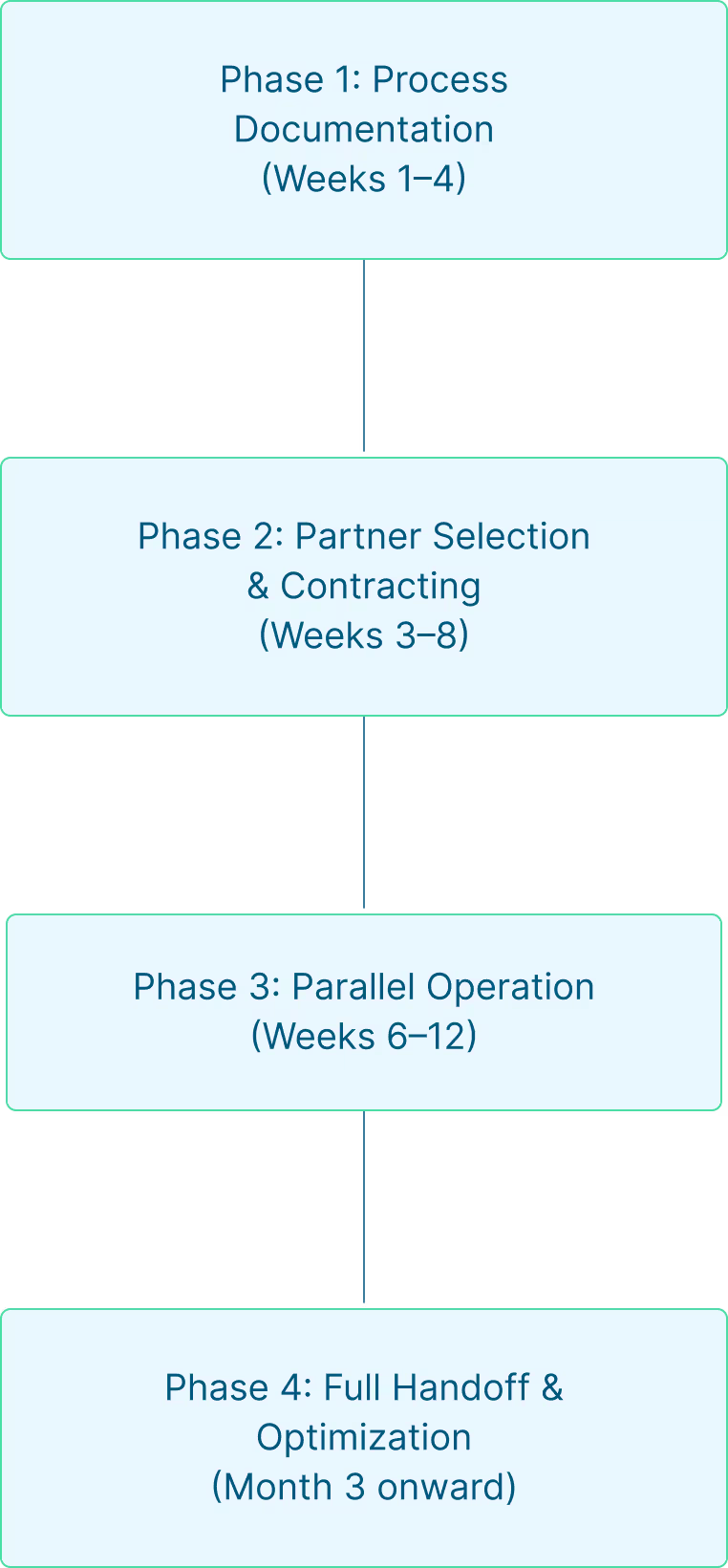
Phase 1 — Process Documentation (Weeks 1–4)
This phase establishes the operational foundation before any offshore team is activated.
- Map all current HR administrative workflows
- Document system access requirements (HRIS, payroll platform, ATS)
- Identify compliance obligations by state and jurisdiction
- Define escalation paths for exception cases
Phase 2 — Partner Selection & Contracting (Weeks 3–8)
Partner evaluation should weight retention infrastructure at least as heavily as cost.
- Evaluate staffing partners on retention infrastructure, not just cost
- Execute Data Processing Agreement (DPA) and PIP-PIC agreements
- Define SLAs: turnaround times, error rates, escalation response
- Confirm ISO 27001 alignment and data security controls
Phase 3 — Parallel Operation (Weeks 6–12)
The parallel operation phase is where most cost savings projections get stress-tested — and where the quality of the staffing partner’s onboarding infrastructure becomes visible.
- Offshore team shadows in-house HR on live workflows
- In-house HR validates offshore output before it goes live
- Identify knowledge gaps and close them before handoff
- Begin cultural integration: team introductions, communication norms
Partners with structured knowledge transfer protocols compress this phase materially. Partners without them extend it — and the extension costs money.
Phase 4 — Full Handoff & Optimization (Month 3 Onward)
Once the offshore team owns administrative workflows end-to-end, the domestic HR function transitions to strategic-only scope.
- In-house HR transitions to strategic-only scope
- Offshore team owns administrative workflows end-to-end
- Monthly performance reviews against SLAs
- Quarterly retention check-ins with staffing partner
Data Security and Compliance: The Non-Negotiable Infrastructure
HR functions are among the most data-sensitive operations a company runs. Payroll records, tax identification numbers, compensation data, performance documentation, and benefits enrollment information are all regulated data categories. When those functions move offshore, the data governance framework must move with them.
Best-practice offshore HR arrangements include:
- Data Processing Agreements (DPAs) executed between the client company (as Personal Information Controller, or PIC) and the offshore staffing partner (as Personal Information Processor, or PIP), as required under the Philippine Data Privacy Act of 2012 (Republic Act 10173) and NPC-mandated PIP-PIC agreement frameworks.
- ISO 27001-aligned information security controls, including role-based access restrictions, encrypted data transmission, and audit logging for systems containing employee personal data.
- Contractual data-residency clauses specifying where employee data may be stored, processed, and accessed — particularly relevant for US companies subject to state-level privacy regulations.
- Incident response protocols that define notification timelines and escalation paths in the event of a data breach or unauthorized access event.
Founders who treat these as boilerplate checkbox items — rather than operational infrastructure — are the ones who face regulatory exposure when something goes wrong. The compliance framework governing offshore HR arrangements is not optional architecture. See the compliance and service structures guide for the governing structure applied to these engagements.
Key Benefits
Replacing or supplementing in-house HR with an outsourced staffing partner delivers advantages that compound over time — provided the transition is structured correctly.
Velocity at Scale
The in-house HR model has a hard ceiling at hypergrowth speed. An offshore staffing partner converts a fixed, headcount-dependent cost center into a modular, scalable operating model. Seats and scope can be added without running a full domestic recruiting cycle.
Strategic HR Capacity Is Freed
When administrative volume is absorbed by an offshore pod, domestic HR leaders can operate at full strategic capacity — culture, performance management, executive hiring — rather than fighting operational fires. In the anonymized composite case studies below, this was the most consistently cited benefit by founders.
Compliance Management Is Partner-Absorbed
A competent offshore staffing partner operating in the Philippines handles registration, remittance, and compliance tracking for Philippine statutory obligations (SSS, PhilHealth, Pag-IBIG) — removing a material administrative burden from the client firm. Multi-state US compliance obligations remain the client’s responsibility but are supported by the offshore team’s administrative throughput.
Modular Scalability Without Linear Headcount Cost
Unlike in-house hiring — where each new HR function requires a new full-time hire — an offshore staffing model allows scope expansion without a full recruiting cycle. This is structurally advantageous for companies whose HR administrative load is uneven across the growth curve.
Rigorous Data Governance as a Byproduct
Counterintuitively, well-structured offshore HR arrangements often produce more rigorous data governance than in-house teams operating under pressure. The contractual requirement to execute DPAs, define data-residency clauses, and align to ISO 27001 controls forces documentation of data flows that many in-house teams never formalize.
Costs & Pricing
The Fully-Loaded Cost Calculation Most Founders Underestimate
The sticker price of an HR generalist in a major US metro is not the real number. The real number is the fully-loaded annual cost: base salary, employer-side payroll taxes, health and dental benefits, 401(k) match, recruiting tools (ATS, HRIS, background check platforms), office overhead allocation, and the cost of the role sitting unfilled during a 60–120+ day recruiting cycle (estimated/illustrative).
Across major US metro markets, that fully-loaded figure for a mid-level HR generalist or HR operations specialist typically falls in the $90,000–$140,000+ annual range (estimated/illustrative — derived from publicly available wage data plus standard benefits loading estimates; actual figures vary materially by market and seniority level).
That is a single headcount. A growth-stage company at 80–150 employees typically needs two to three HR operations staff to manage the administrative load at scale — before accounting for a strategic HR business partner or VP of People. The math compounds quickly.
The Offshore Alternative
An offshore staffing partner operating in the Philippines can deliver an HR-support pod — covering payroll administration, onboarding documentation, benefits coordination, and compliance tracking — at a per-seat cost that operators commonly estimate at 40–60% below the fully-loaded equivalent US hire (estimated/illustrative composite estimate; actual savings depend on role complexity, location arbitrage, and management overhead investment required).
Philippine Statutory Cost Structure: What Offshore Partners Absorb
When a US tech company engages an offshore staffing partner in the Philippines, the partner — as the Philippine legal employer under the staffing arrangement — absorbs and manages Philippine statutory employer obligations:
| Statutory Contribution | Administering Body | Employer-Side Obligation |
| Social Security System (SSS) | Social Security System of the Philippines | Mandatory employer contribution per published schedule |
| National Health Insurance | PhilHealth | Employer premium contribution per rate schedule |
| Housing Fund | Pag-IBIG Fund | Mandatory employer contribution |
Collectively, these statutory contributions add approximately 12–15% above base salary in mandatory employer-side costs (estimated/illustrative — consistent with published statutory contribution schedules from SSS, PhilHealth, and Pag-IBIG; actual percentage varies with salary level and applicable rate tiers). A competent offshore staffing partner handles registration, remittance, and compliance tracking for all three.
Year-One vs. Year-Two Economics
The savings are real — but back-weighted, for the reasons already covered above: knowledge transfer, parallel operation, and data governance setup all land in year one, before the offshore pod is running at full efficiency. Model your first-year projection closer to that 25–30% range rather than the steady-state number, and treat the gap between the two as the cost of doing the transition properly rather than a sign something went wrong.
For a detailed breakdown of engagement structures and per-seat pricing, see offshore team pricing and engagement models.
Global Case Studies
Anonymized composite case studies based on engagements and general industry observation. No real named firms are referenced.
Case A — Series A SaaS Company ($4M–$12M ARR)
A two-person in-house HR generalist team was managing payroll administration, onboarding documentation, benefits coordination, and first-pass recruiting for a 60-person company growing toward 100. Neither generalist had bandwidth for strategic work.
The company engaged an offshore staffing partner to absorb the administrative functions, redirecting the savings toward a VP of People focused exclusively on culture, performance management, and executive hiring. The transition took approximately 10 weeks, including parallel operation. By month four, the VP of People was operating at full strategic capacity — a role that had previously been deferred for two funding cycles due to budget constraints.
Case B — US Fintech Scale-Up (80–150 Headcount)
A fintech company facing rapid headcount growth modeled the cost of hiring equivalent HR operations staff in a Tier-1 US city at $280,000+ annually for two mid-level specialists (estimated/illustrative composite figure). The offshore alternative — a dedicated HR-support pod standing up within 60 days — came in materially below that figure on a per-seat basis.
The primary friction point was data security: the company’s compliance team required three additional weeks to review and negotiate the DPA and data-residency clauses before the engagement could go live. That friction was productive — the resulting data governance framework was more rigorous than what the in-house team had been operating under.
Case C — Bootstrapped B2B Software Company
A company that grew 3x in headcount over 18 months found its single in-house HR manager unable to simultaneously manage compliance, onboarding, and recruiting. The resolution was not to hire two additional in-house HR staff — the budget did not support it.
Instead, the company outsourced HR administration offshore and retained one strategic HR business partner domestically. The offshore team handled the volume; the domestic HRBP handled the judgment calls. Attrition in the offshore pod during year one was lower than the general pattern observed in poorly structured engagements, an outcome the founder attributed to deliberate investment in career pathing and quarterly performance conversations with the staffing partner’s account team.
Philippines Relevance & Local Examples
Why the Philippines Specifically
The Philippines is not the default offshore destination for HR-support functions because it is cheap. It is the default because the combination of factors that make HR operations work — English fluency, familiarity with US business norms, a large pool of college-educated workers, and time-zone overlap with US West Coast operations — converges there more reliably than in most alternative markets.
The Philippine IT-BPM sector employs over 1.5 million workers (estimated/illustrative — consistent with sector-level data from Philippine industry and government sources; verify against current publications for latest figures) and has grown into one of the country’s largest export industries. That scale matters for founders evaluating talent-pool depth. A staffing partner operating in Metro Manila or Cebu is drawing from a labor market that has been producing knowledge-process workers for US and Australian clients for over two decades. The institutional knowledge of how to operate within Western business frameworks is embedded in the workforce, not something that needs to be built from scratch.
Regional Nuance: Metro Manila vs. Secondary Hubs
Regional location within the Philippines materially affects both cost and retention outcomes.
Metro Manila (Makati, BGC, Ortigas) offers the deepest talent pool and the most established BPO infrastructure, but also carries higher wage expectations and higher attrition rates driven by competitive poaching. Secondary hubs — Cebu, Davao, Clark — often deliver lower attrition and competitive wage structures, at the cost of a somewhat shallower specialist talent pool for highly technical roles. For HR administration functions, secondary hubs frequently outperform Manila on retention metrics.
Philippine Statutory Framework: What the Offshore Partner Manages
When a US tech company engages an offshore staffing partner in the Philippines, the partner — as the Philippine legal employer under the staffing arrangement — absorbs and manages Philippine statutory employer obligations. This staffing model is structurally different from a formal Employer of Record (EOR) or Professional Employer Organization (PEO) arrangement.
Under an EOR model, the EOR legally employs the worker in their home jurisdiction, and the client company has no direct employment relationship. Under a Philippine offshore staffing arrangement, the staffing partner employs the worker under Philippine labor law, and the client company directs the work. The distinction matters for IP ownership, data governance, and operational control.
The Philippine Data Privacy Act of 2012 (Republic Act 10173) governs how offshore teams may process US employee data, requiring properly executed DPAs designating the offshore partner as a Personal Information Processor (PIP) and the US client as Personal Information Controller (PIC). NPC-mandated PIP-PIC agreement frameworks apply.
Comparison Table
The following matrix maps the key decision criteria across the two primary models for growth-stage tech companies evaluating HR infrastructure.
| Criterion | In-House HR Team | Offshore Staffing Partner |
| Time to operational capacity | 60–120+ days (recruiting cycle alone) (illustrative) | 30–60 days with structured onboarding |
| Fully-loaded annual cost (US) | $90,000–$140,000+ per headcount (illustrative) | Typically 40–60% below US equivalent (illustrative) |
| Scalability | Linear — each new function requires a new hire | Modular — add seats or scope without full recruiting cycle |
| Compliance management | Client-managed | Partner-managed (Philippine statutory obligations) |
| Data security controls | Internal IT/HR responsibility | Contractually defined; ISO 27001 alignment standard |
| Strategic HR capacity | Consumed by administrative volume at scale | Freed up by offloading administrative load |
| Year-one attrition risk | Low (domestic, established team) | Moderate — requires deliberate retention investment |
| IP and data governance | Fully internal | Requires DPA, PIP-PIC agreements, data-residency clauses |
| Cultural alignment | Native | Requires structured integration; Philippines has strong baseline |
Conclusion & Actionable Takeaway
The replacement of in-house HR with outsourced staffing partners is not a cost-cutting tactic dressed up as strategy. For growth-stage tech companies, it is a structural response to a real architectural problem: HR infrastructure cannot scale at the same velocity as hypergrowth headcount without either breaking the existing team or consuming capital that should be going into product and go-to-market.
The model works when three conditions are met:
- The staffing partner has demonstrable retention infrastructure.
- The client firm invests in process documentation and parallel operation before full handoff.
- The data governance framework — DPAs, PIP-PIC agreements, ISO 27001-aligned controls — is treated as operational infrastructure rather than legal boilerplate.
The firms that get this right end up with a leaner domestic HR function focused entirely on strategic people operations, an offshore administrative pod that handles volume at a fraction of the US cost, and a compliance posture that is more rigorous than what the in-house team was managing under pressure.
The firms that get it wrong skip the parallel operation phase, select on price, and discover six months later that they have traded one set of HR problems for a different, harder-to-fix set.
Actionable next step: Evaluate your current HR cost structure against the offshore team pricing and engagement models framework. If your in-house HR team is spending more than 60% of its time on administrative tasks, the structural case for outsourcing that load is already made.
FAQs
Can an offshore HR-support team legally process US employee payroll data under Philippine law?
Yes — provided the arrangement is governed by a properly executed Data Processing Agreement (DPA) designating the offshore partner as a Personal Information Processor (PIP) under the Philippine Data Privacy Act of 2012 (Republic Act 10173), with the US client firm acting as Personal Information Controller (PIC). The DPA must specify data categories, processing purposes, retention limits, and breach notification obligations. NPC-mandated PIP-PIC agreement requirements apply. US-side obligations — including any applicable state privacy laws — remain the client firm’s responsibility and should be addressed in the same contractual framework.
What is the practical difference between an offshore staffing partner and an Employer of Record (EOR) for Philippine-based HR staff?
Under an offshore staffing arrangement, the Philippine staffing partner is the legal employer of the offshore workers under Philippine labor law, and the client company directs the work operationally. Under an EOR model, the EOR employs the worker in their home jurisdiction, and the client has no direct employment relationship — the EOR handles all local HR, payroll, and compliance. The staffing model gives the client more operational control and typically lower per-seat cost; the EOR model reduces the client’s compliance exposure but at higher cost and with less direct management authority. For HR-support functions requiring tight process integration, the staffing model is generally preferred.
How should a growth-stage tech company structure SLAs with an offshore HR-support partner to protect against quality degradation?
SLAs for offshore HR-support pods should define: (1) turnaround time standards for routine tasks (e.g., onboarding documentation completed within X business hours of hire confirmation); (2) error rate thresholds for payroll processing and benefits enrollment; (3) escalation response times for exception cases; and (4) monthly reporting cadence on team utilization, attrition, and open items. Critically, SLAs should include a remediation protocol — not just a penalty clause — specifying what the partner must do when a threshold is missed. Penalty-only SLAs create adversarial dynamics; remediation-first SLAs create accountability with a path forward.
What ISO 27001 controls are most operationally relevant when an offshore team handles employee HR data?
The highest-priority controls for offshore HR data handling are: role-based access restrictions (ensuring offshore staff can only access data required for their specific function), encrypted data transmission between client systems and offshore environments, audit logging for all access to systems containing personal employee data, and a documented incident response plan with defined notification timelines. Physical security controls at the offshore facility — clean-desk policies, restricted device usage, no-screenshot protocols — are equally important and frequently underweighted in due diligence. Verify that the staffing partner’s ISO 27001 certification (if held) covers the specific facility and team that will handle your data, not just the parent organization.
Related Services & Next Steps
Growth-stage tech companies evaluating the shift from in-house HR to an outsourced staffing model typically require support across several adjacent areas. The following resources and service areas are relevant to the decision and implementation process.
Compliance Framework
The data governance infrastructure governing offshore HR arrangements — DPAs, PIP-PIC agreements, ISO 27001-aligned controls, and data-residency clauses — is documented in the compliance and service structures guide. Review this before contracting with any offshore staffing partner.
Onboarding Checklist
The parallel operation phase is the highest-risk period in any offshore HR transition. The structured onboarding checklist in the Philippines data compliance and onboarding checklist covers process documentation requirements, system access protocols, SLA definition, and cultural integration steps.
Pricing and Engagement Structures
Per-seat cost structures, pod configurations, and engagement models for offshore HR-support functions are detailed in offshore team pricing and engagement models. Use this to build the build-vs-buy cost model for your current headcount band.
Home
For an overview of the full range of offshore staffing capabilities available to growth-stage tech companies, see OffshorePH.
