
A remote executive assistant (remote EA) is a full-time or part-time professional who manages administrative, coordination, and operational support tasks for a senior executive — working entirely off-site, often across time zones. For US startup CEOs, Philippine-based remote EAs offer a combination of high English proficiency, US-aligned work culture, and significant labor cost arbitrage, making them a structurally sound hire at earlier company stages than most founders consider.
Anonymized composite case studies appear throughout this article, drawn from offshore staffing engagements. No real company names, financials, or incidents are attributed to named firms.
Why the Timing Argument Is Counterintuitive — and Correct
Most founders wait until they are drowning before they hire administrative support. The instinct is understandable: headcount feels like overhead, and early-stage discipline around burn is legitimate. But the timing logic inverts under scrutiny.
Startup CEOs in seed-to-Series B stages typically spend an estimated 15–25% of their working hours on tasks that do not require founder-level judgment — inbox triage, calendar management, travel coordination, vendor follow-up, CRM data entry. That is not a productivity observation. It is a capital allocation problem. If a founder’s time is the company’s scarcest resource, then 15–25% of it being consumed by delegable work is a structural inefficiency that compounds weekly.
The compounding problem runs in both directions. Founders who delay EA hiring until they are overwhelmed face a longer, harder onboarding ramp — because they lack the bandwidth to train and delegate effectively during a crunch. A founder mid-fundraise, mid-hiring sprint, and mid-product launch simultaneously cannot give a new EA the attention required to build systems and context. The EA underperforms. The founder concludes the hire was premature. The actual cause was the timing.
Founders who hire early — before the crunch — consistently observe the inverse experience. The EA ramps during a lower-pressure window, learns systems and stakeholder context with founder attention available, and is fully operational before the growth sprint hits.
The Asymmetric Hire: Cost vs. Founder Time
Here is the operational math most seed-stage CEOs run too late: a full-time remote executive assistant based in the Philippines typically costs 60–80% less than a US-market equivalent, all-in. Add Philippine statutory employer obligations — SSS, PhilHealth, Pag-IBIG, and 13th month pay — and the total employer cost lands approximately 12–15% above base salary. The resulting monthly spend is, in most cases, less than the founder’s own effective hourly rate multiplied by the administrative hours they are currently absorbing personally.
That gap is the entire thesis.
What a Remote EA Is Not
A remote EA is not a virtual assistant marketplace gig. The distinction matters operationally. A marketplace VA handles discrete, low-context tasks. A remote EA builds institutional knowledge — your communication style, your investor relationships, your vendor preferences, your calendar logic. That knowledge compounds. It cannot be rebuilt each time you cheaply churn a contractor.
Calendar Sovereignty: The Operational Concept Driving Early Adoption
“Calendar sovereignty” — the deliberate protection of founder deep-work blocks from reactive scheduling — is the most frequently cited driver of early EA adoption among startup operators. It is not a soft benefit. Unmanaged calendars are a documented source of founder burnout in early-stage companies, and burnout at the CEO level is an existential company risk, not a personal wellness issue.
A remote EA enforces calendar logic that a founder cannot enforce for themselves. The founder is too close to the pressure. When an investor requests a call, the founder’s instinct is to say yes immediately and find the time. The EA’s function is to find the time without sacrificing the deep-work blocks that produce the work the investor is calling about.
This is not a luxury function. It is a structural operating decision.
How It Works
The Founder Time Audit: The Diagnostic That Justifies the Hire
Before scoping an EA role, the most operationally rigorous founders run a two-week time audit — a structured log of how every working hour is allocated across task categories. The output is not a productivity score. It is a delegation map.
One anonymized composite: a US-based e-commerce startup CEO in the $2–5M ARR range ran a two-week time audit and identified that roughly 22% of working hours were spent on tasks an EA could absorb without any loss of quality or judgment. That audit output became the EA’s initial task brief directly. Role ambiguity — one of the primary drivers of slow EA ramp — was eliminated before day one.
The audit surfaces three things a job description cannot:
- Actual task volume — not estimated, not assumed
- Task categories — which determine whether you need a generalist EA, a specialist, or a hybrid
- Delegation readiness — whether the founder has documented processes or is operating entirely from tribal knowledge
Without this diagnostic, EA roles are frequently scoped too narrowly, then expanded reactively.
The Full Task Stack a Remote EA Can Own
The task categories a well-scoped remote EA can own are broader than most founders initially assume:
| Task Category | Specific Functions |
| Calendar Management | Deep-work block protection, meeting scheduling, conflict resolution, time-zone coordination |
| Inbox Management | Triage, draft responses, flag priority items, unsubscribe hygiene |
| Travel & Expense | Booking, itinerary management, expense report compilation |
| CRM & Investor Relations | Data entry, follow-up sequencing, investor update drafts, warm contact tracking |
| Vendor & Contractor Coordination | Onboarding paperwork, invoice tracking, communication relay |
| Board & Meeting Prep | Pre-read compilation, agenda drafting, action item tracking |
| Research & Briefing | Competitive snapshots, prospect research, light market summaries |
| Social & Content Scheduling | Post scheduling, engagement monitoring, content calendar maintenance |
| Chief of Staff Lite Functions | OKR tracking support, stakeholder communication drafts, cross-functional follow-up |
Phase Risk Analysis: Where EA Implementations Fail
Remote EA Implementation Phase Risk Map
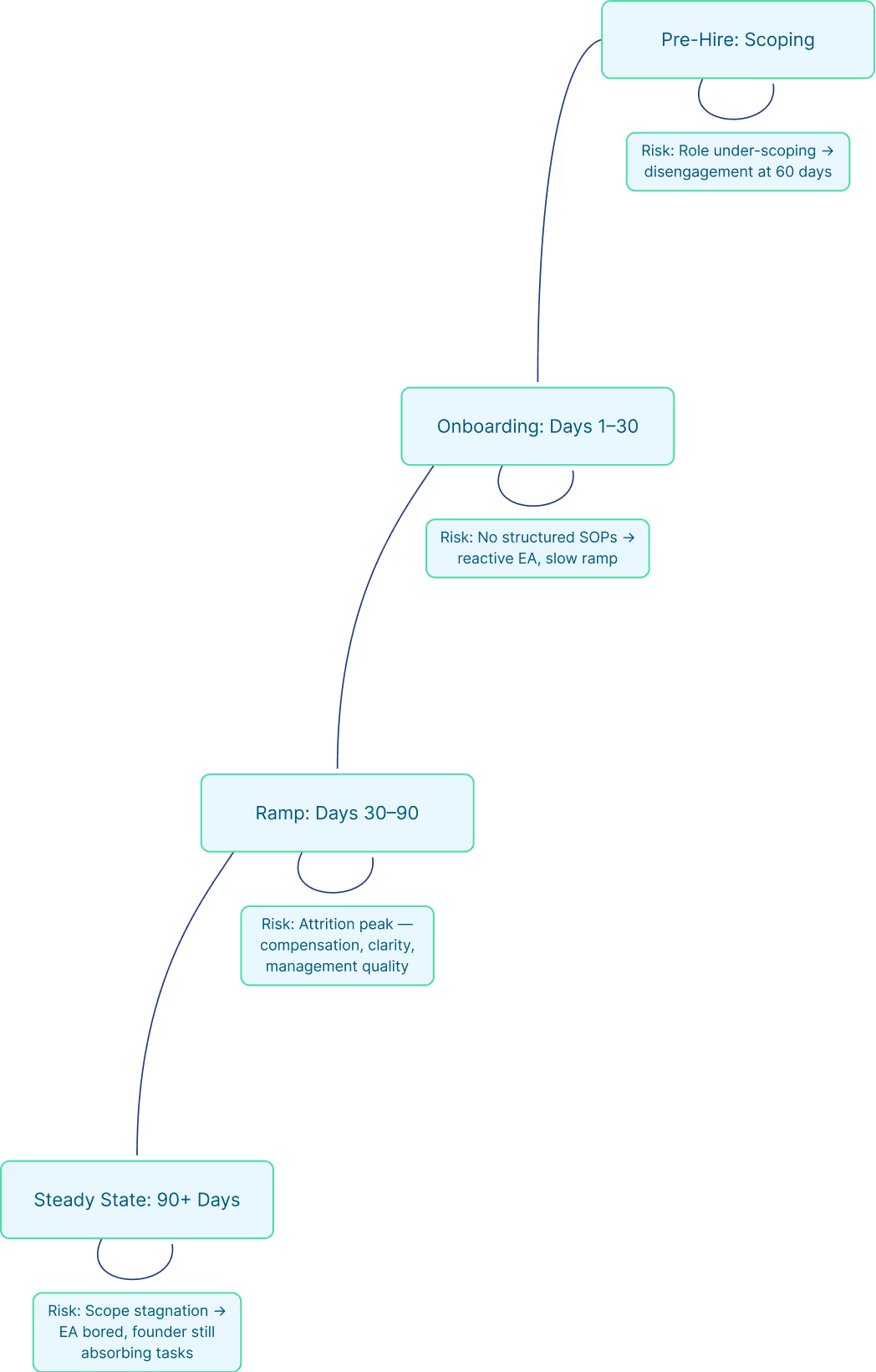
Phase 1 — Scoping (Pre-Hire): The most common failure is role under-scoping. Founders define the EA role as “calendar management” and nothing else, then are surprised when the EA is underutilized and disengaged within 60 days. A time audit before scoping prevents this.
Phase 2 — Onboarding (Days 1–30): Founders who do not allocate structured onboarding time — daily check-ins, documented SOPs, explicit communication preferences — produce EAs who default to asking for permission rather than taking initiative. The EA learns to be reactive because the founder never modeled proactive delegation.
Phase 3 — Ramp (Days 30–90): Attrition risk peaks here. The EA has enough context to recognize whether the role matches what was described in hiring. If compensation is below market, role clarity is low, or management quality is poor, this is when departures happen. Proactive compensation benchmarking and structured 30/60/90-day check-ins materially reduce this risk.
Phase 4 — Steady State (90+ Days): The primary failure mode at steady state is scope stagnation. The EA’s capacity grows as systems mature, but the founder does not expand delegation. The EA becomes bored; the founder continues absorbing tasks they should not be touching. A quarterly role review — explicit conversation about what the EA could absorb next — prevents this.
Compliance Architecture: What the Legal Layer Actually Requires
Philippine Data Privacy Act (Republic Act 10173): Any remote EA handling personal data — investor contact records, customer CRM data, employee information — is subject to the Philippine Data Privacy Act of 2012, enforced by the National Privacy Commission (NPC). Engagements involving personal data processing require a Data Processing Agreement (DPA) between the engaging company and the EA or their employer. Where applicable, NPC-mandated PIP-PIC agreements govern the personal information processor and personal information controller relationship.
Probationary Employment and Regularization: Under the Labor Code of the Philippines (Article 296), probationary employment cannot exceed six months. After six months, a direct-hire employee is entitled to regularization — which carries additional statutory obligations and termination protections. This is a material compliance consideration for founders who structure engagements as direct hires rather than through a staffing agency or employer-of-record provider.
Engagement Structure Options:
| Structure | Compliance Burden | Cost | Flexibility |
| Direct Hire | Full Philippine labor law compliance on founder | Lowest ongoing cost | Lowest — regularization obligations apply |
| Staffing Agency | Agency holds employer-of-record liability | Moderate markup | High — agency manages statutory compliance |
| Employer-of-Record (EOR) | EOR holds all employer liability | Highest markup | Highest — full statutory and HR outsourcing |
For early-stage startups without a dedicated HR or legal function, the staffing agency or EOR structure is operationally lower-risk. The markup is real, but so is the compliance complexity it eliminates.
Key Benefits
The ‘Chief of Staff Lite’ Evolution: What Early Hiring Unlocks
Founders who hire remote EAs early — before the crunch — consistently observe a scope expansion pattern that late-hire founders do not experience. The EA, having built institutional knowledge during a lower-pressure ramp, is positioned to absorb higher-complexity functions as the company scales.
One SaaS operator’s EA started on inbox and calendar duty and, within eight months, was running investor updates and prepping board materials — see the full trajectory in the case studies below.
A DTC founder saw the same pattern in 90 days rather than eight months — calendar management expanding into supplier communication and financial reconciliation without ever formally redefining the role.
This is the compounding return on early hiring. The EA who ramps during a low-pressure period becomes a high-leverage operator during the high-pressure period. The EA hired during the crunch is still learning the calendar system while the founder is closing a funding round.
Structural Benefits at a Glance
- Calendar sovereignty: Deep-work blocks are protected by a professional whose sole function is to enforce them — not by the founder’s willpower against investor pressure.
- Institutional knowledge compounding: Unlike a marketplace VA, a remote EA builds context over months and years. That context is an operational asset.
- Delegable task recapture: Founders who complete structured onboarding commonly find they recapture an estimated 8–15 hours per week within 60 days — time that returns to product, fundraising, and team leadership.
- Scalable scope: The EA role in a startup context grows organically as trust and systems mature, from administrative support to junior chief of staff functions, without a proportional cost increase.
- Compliance-ready engagement: Structured through a staffing agency or EOR, the engagement carries no direct Philippine labor law exposure for the founder.
Costs & Pricing
Fully Loaded Cost Comparison (Illustrative)
| Cost Component | US-Based EA (Illustrative) | Philippine Remote EA (Illustrative) |
| Base Salary (Annual) | $55,000–$75,000 | $10,000–$18,000 |
| Employer Payroll Taxes / Benefits | $12,000–$20,000 | $1,200–$2,700 (statutory: ~12–15% above base) |
| Office / Equipment | $3,000–$6,000 | Minimal (remote) |
| Recruiting / Agency Fee | $8,000–$15,000 (one-time) | $1,500–$5,000 (one-time or monthly markup) |
| Estimated Annual Total | $78,000–$116,000 | $12,700–$25,700 |
All figures are illustrative ranges. Actual costs vary with role seniority, engagement structure (direct hire vs. staffing agency vs. employer-of-record), and compensation benchmarking at time of hire.
The arbitrage is real. But the table above represents the ceiling of the cost benefit — the best-case scenario. The floor requires equal attention.
Hidden Costs Operators Underestimate
- Onboarding time investment: A founder must spend meaningful hours in weeks one through four building systems, documenting processes, and establishing communication norms. Founders who skip this step tend to experience slower ramp times and higher early attrition.
- Tooling and access provisioning: Password managers, role-appropriate CRM access, communication platform seats, and data handling protocols all require setup time and, in some cases, incremental software cost.
- Attrition risk in year one: In offshore staffing arrangements where onboarding structure, role clarity, and compensation benchmarking are not managed proactively, year-one attrition can be meaningful — illustratively reaching mid-teens to 30% in unstructured engagements. Replacing an EA who has built six months of institutional knowledge is expensive in ways that do not appear in the cost table.
- Management overhead: A remote EA requires active management. Founders who have never managed remote staff, or who have never delegated administrative functions before, face a learning curve that temporarily increases their workload before it decreases it.
Compensation Benchmarking
Philippine statutory costs — SSS, PhilHealth, Pag-IBIG, and 13th month pay — add approximately 12–15% above base salary and must be factored into the total package. Operators who benchmark at or above the 60th percentile for comparable roles in Metro Manila or Cebu tend to observe materially lower year-one attrition than those who optimize for the lowest possible rate. The cost difference between the 40th and 60th percentile is typically small relative to the replacement cost of an EA who exits at month five with six months of institutional knowledge.
For current engagement structures and pricing tiers, see offshore team pricing and engagement models.
Global Case Studies
All case studies below are anonymized composites based on offshore staffing engagements. No real company names, financials, or incidents are attributed to named firms.
Bootstrapped SaaS Operator — Early Hire, Expanding Scope
A bootstrapped SaaS operator hired a remote EA at the 8-employee mark, initially scoped to inbox and calendar management. By month four, the EA was managing the company’s investor update cadence — drafting monthly update emails, tracking follow-up commitments, and maintaining a CRM of warm contacts. By month eight, the EA was preparing board pre-reads and tracking OKR progress across functional leads. None of this was in the original job description. All of it was possible because the EA had the institutional context to execute it.
DTC Brand Founder — Organic Scope Expansion Within 90 Days
A DTC brand founder (anonymized composite) started with a remote EA scoped exclusively to calendar management. Within 90 days, the EA had absorbed supplier communication, influencer outreach coordination, and light financial reconciliation. The expansion was organic, driven by established trust and documented systems — not by a formal role redesign.
US-Based E-Commerce CEO — Time Audit as Scoping Tool
The e-commerce CEO’s time audit — detailed earlier in this article — is worth revisiting here as a case study in its own right: a structured two-week log turned a vague sense of being overloaded into a specific, defensible EA task brief, and eliminated the role ambiguity that derails most early hires.
Series A B2B Software Company — Compliance-First Engagement Structure
A Series A B2B software company (anonymized composite) structured its remote EA engagement through a Philippine staffing agency specifically to avoid direct-hire statutory compliance complexity. The arrangement included a Data Processing Agreement covering CRM and investor data handled by the EA — a requirement surfaced by the company’s legal counsel under the Philippine Data Privacy Act. The agency managed SSS, PhilHealth, Pag-IBIG, and 13th month pay obligations. The founder’s legal and HR exposure was effectively zero.
Philippines Relevance & Local Examples
Why the Philippines Specifically
The Philippines is not the only offshore staffing market, but it is the dominant one for US-facing executive support roles for specific structural reasons.
English proficiency is not merely high — it is culturally embedded. The Philippine educational system operates substantially in English, and the country’s BPO and knowledge-process outsourcing sector has spent two decades producing professionals who communicate in US business idiom, not translated equivalents.
US cultural alignment reduces the friction that plagues other offshore markets. Philippine professionals are familiar with US business norms, communication cadence, and professional expectations — a product of historical ties and decades of US-facing service industry development.
Labor market depth is substantial. The IT-BPM sector in the Philippines employs well over a million workers, with a pipeline of college-educated professionals entering the workforce annually. For executive support roles specifically, the supply of candidates proficient in Google Workspace, Notion, Slack, Asana, HubSpot, and Zoom is deep enough that SaaS tool proficiency is a baseline expectation, not a differentiator.
Time-zone flexibility is a real operational consideration. The Philippines operates at UTC+8, which creates zero to four hours of natural business-day overlap with US time zones. In practice, Philippine remote professionals in the staffing sector routinely adopt shifted schedules to align with US business hours — this is standard practice, not an exception. The overlap question is a scheduling conversation, not a structural barrier.
Philippine Statutory Compliance Obligations
Founders engaging Philippine-based staff directly must account for the following statutory employer obligations:
- SSS (Social Security System): Mandatory employer and employee contributions
- PhilHealth: National health insurance contributions
- Pag-IBIG (HDMF): Housing fund contributions
- 13th Month Pay: Mandatory under Presidential Decree 851, equivalent to one month’s base salary, payable by December 24 annually
These obligations add approximately 12–15% above base salary to the total employer cost — a figure that must be factored into any direct-hire cost model. Staffing agency and EOR structures absorb these obligations on the founder’s behalf.
Philippine Data Privacy Act: Local Compliance Context
The Philippine Data Privacy Act of 2012 (Republic Act 10173), enforced by the National Privacy Commission (NPC), applies to any remote EA handling personal data — investor contact records, customer CRM data, employee information. A Data Processing Agreement (DPA) is required regardless of engagement structure when personal data is processed. NPC-mandated PIP-PIC agreements govern the personal information processor and personal information controller relationship where applicable.
This is not a theoretical risk. A remote EA with access to your CRM, investor database, or HR records is processing personal data under Philippine law. The DPA requirement is real and enforceable. See the compliance and service structures guide for a structured compliance checklist.
Comparison Table
Early Hire vs. Delayed Hire Outcomes
| Dimension | Early Hire (Pre-Crunch) | Delayed Hire (Post-Overwhelm) |
| Onboarding Quality | High — founder has bandwidth to train | Low — founder is distracted by crunch |
| Ramp Duration | 30–60 days (illustrative) | 60–120 days (illustrative) |
| Role Scope at 6 Months | Expanded organically | Often still at initial narrow scope |
| Attrition Risk | Lower — structured onboarding, clear role | Higher — ambiguity and founder inattention |
| Founder Time Recaptured | 8–15 hours/week within 60 days (illustrative) | Delayed; often 90+ days to meaningful recapture |
| Compliance Setup | Deliberate — DPA, engagement structure chosen proactively | Reactive — often skipped under time pressure |
| Cost | Identical monthly spend | Identical monthly spend + higher replacement risk |
Engagement structure: See the full comparison of Direct Hire, Staffing Agency, and EOR structures in the Compliance Architecture section above — the trade-off in short: direct hire is cheapest but puts full Philippine labor law exposure on the founder; staffing agency and EOR shift that liability off at a markup.
Fully-loaded cost: See the complete US-vs-Philippine cost breakdown in the Costs & Pricing section above — the short version: a Philippine remote EA typically lands at $12,700–$25,700 annually all-in, versus $78,000–$116,000 for a US-based equivalent (illustrative).
All figures are illustrative. Actual costs vary with seniority, engagement structure, and compensation benchmarking at time of hire.
Conclusion & Actionable Takeaway
The remote EA hire is not a comfort hire. It is a capital allocation decision. Founder time is the company’s most expensive and least renewable resource. When an estimated 15–25% of that time is consumed by tasks a well-scoped remote EA can absorb, the ROI calculation is not close — even before accounting for the compounding value of an EA who builds institutional knowledge over 12 to 24 months.
The structural argument for early hiring is stronger than most founders recognize: the cost of the hire is fixed whether you hire early or late; the return is substantially higher when you hire early. The EA who ramps during a low-pressure window is operationally ready when the growth sprint hits. The EA hired during the sprint is a liability before they become an asset.
The four-step action sequence:
- Run the time audit. Two weeks, structured log, every working hour categorized. The output is your delegation map and your EA’s initial task brief.
- Scope the role from the audit output. Not from a generic job description. From your actual task volume and categories.
- Choose the engagement structure that matches your compliance tolerance. Direct hire carries full Philippine labor law exposure. Staffing agency or EOR structures eliminate that exposure at a moderate markup.
- Execute the onboarding with the same rigor you would apply to a product launch. Daily check-ins in week one, documented SOPs, explicit communication preferences, structured 30/60/90-day reviews.
Founders who treat this hire as a strategic infrastructure decision — not an administrative convenience — are the ones who observe compounding returns over time. Those who wait until they are overwhelmed consistently find that the hire takes longer to pay off than it should have.
For a structured onboarding framework and engagement options, see Philippines data compliance and onboarding checklist and offshore team pricing and engagement models.
FAQs
If I hire a remote EA through a Philippine staffing agency, do I still need a Data Processing Agreement?
Yes — a Data Processing Agreement (DPA) is required regardless of engagement structure when the EA handles personal data, because the DPA governs the data processing relationship between your company (as personal information controller) and the EA or their employer (as personal information processor) under the Philippine Data Privacy Act of 2012. The staffing agency holds employer-of-record liability for labor law purposes, but data privacy obligations run separately and must be documented in a standalone DPA. Your legal counsel should review the agreement before the EA is granted access to CRM, investor, or employee data.
What happens to a direct-hire Philippine remote EA after six months — can I terminate the arrangement if it is not working?
Under the Labor Code of the Philippines (Article 296), a probationary employee who is not regularized within six months and who has not been given written notice of performance standards at the time of engagement may be entitled to regularization by operation of law. Termination of a regularized employee requires just or authorized cause and due process under Philippine labor law. This is a material compliance risk for direct-hire arrangements. Founders who want flexibility without this exposure should structure the engagement through a staffing agency or employer-of-record provider, which holds the employer-of-record relationship and manages regularization obligations.
How do I benchmark compensation for a Philippine remote EA to reduce year-one attrition risk?
Compensation benchmarking should reference current Philippine labor market rates for the specific role seniority and task scope — not generic “VA” rates, which are typically lower and attract a different candidate profile. Philippine statutory costs (SSS, PhilHealth, Pag-IBIG, 13th month pay) add approximately 12–15% above base salary and must be factored into the total package. Operators who benchmark at or above the 60th percentile for comparable roles in Metro Manila or Cebu tend to observe materially lower year-one attrition than those who optimize for the lowest possible rate. The cost difference between the 40th and 60th percentile is typically small relative to the replacement cost of an EA who exits at month five with six months of institutional knowledge.
Can a remote EA handle investor relations functions without creating confidentiality or legal exposure?
Yes, with appropriate controls. The EA should operate under a confidentiality agreement (NDA) as a baseline. If the EA is accessing investor CRM data, cap table information, or board materials, a Data Processing Agreement covering those data categories is required under the Philippine Data Privacy Act. Access should be role-scoped — the EA should have access to the specific systems and data categories required for their functions, not broad administrative access to all company systems. Founders who implement these controls at onboarding — rather than retroactively — tend to encounter fewer legal friction points and faster legal counsel sign-off on the engagement structure.
Related Services & Next Steps
Explore the following resources to move from evaluation to execution:
- OffshorePH — Overview of OffshorePH’s remote staffing model for US-based startups
- Philippines data compliance and onboarding checklist — Structured EA onboarding framework for founders
- offshore team pricing and engagement models — Engagement structures, pricing tiers, and statutory cost breakdowns
- compliance and service structures guide — Data Processing Agreement templates and Philippine labor law compliance guide for remote EA engagements
