
IT staff outsourcing is the practice of engaging offshore or nearshore developers, QA engineers, DevOps specialists, or technical support staff through a third-party employer-of-record or staffing provider. The client retains direct control over technical direction, tooling, sprint cadence, and delivery standards; the provider manages HR, payroll, statutory compliance, and facilities. This model is not traditional project outsourcing — the client owns the backlog and the architecture; the provider owns the employment relationship.
Anonymized composite case studies based on engagement patterns observed across offshore IT staffing arrangements. No real named-firm incidents are depicted.
Three converging structural forces have accelerated the shift toward offshore IT staffing for tech companies.
Post-2020 Remote Normalization
Distributed engineering teams are now standard operating procedure. GitHub-based workflows, async standups, and cloud-native development environments have largely eliminated the integration friction that once made offshore developers feel like second-class team members.
Talent Scarcity in US Markets
Senior QA engineers, DevOps specialists, and full-stack developers remain in short supply domestically. Competition for roles like Software Development Engineer in Test (SDET) has pushed compensation to levels that compress margins at Series A and B companies.
Philippine IT-BPM Infrastructure Maturity
The Philippines’ IT-BPM sector employs over 1.5 million workers and generates tens of billions of USD in annual export revenues. This is not an emerging market experiment — it is a mature, government-supported industry with deep institutional infrastructure.
The structural economics are direct. A senior software developer in a US coastal market commands a total compensation package — salary, equity, benefits, payroll taxes, and employer-side insurance — that can run well above $200,000 annually in fully loaded terms. Philippine statutory employer obligations are bounded and transparent: SSS, PhilHealth, Pag-IBIG contributions, and 13th-month pay add approximately 12–15% above base salary — a fraction of the 30–40%+ employer burden typical in the United States.
For a 10-person engineering team, that gap represents a material structural cost difference that compounds annually.
The Two Delivery Models: Staff Augmentation vs. Managed Service Delivery
Before building a cost model, tech leaders must resolve a foundational structural question. These two models carry different IP, liability, and integration implications.
| Dimension | Staff Augmentation | Managed Service Delivery |
| Technical direction | Client owns sprint, backlog, architecture | Vendor owns output and SLAs |
| IP ownership | Work-for-hire clauses in employment contracts | Requires explicit IP assignment provisions |
| Integration depth | Deep — offshore staff in client tools/repos | Shallow — vendor manages internal workflow |
| Accountability model | Client-managed performance | Vendor-managed KPIs |
| Best fit | Engineering teams needing capacity extension | Discrete functions with defined deliverables |
| Compliance exposure | Client retains data controller obligations | Shared or vendor-side, depending on DPA structure |
For most tech companies — particularly SaaS, fintech, and digital product firms — staff augmentation is the operative model. The client keeps the tech stack, the sprint cadence, the code review process, and the deployment pipeline. The offshore provider handles HR, payroll, statutory compliance, and physical infrastructure.
For a broader view of how this model applies across business sizes and functions, see Staff Outsourcing for Small and Medium Businesses: The Complete Playbook.
How It Works
The offshore IT staffing engagement lifecycle moves through four distinct phases, each with its own failure modes and mitigation levers.
Offshore IT Staffing Engagement Lifecycle
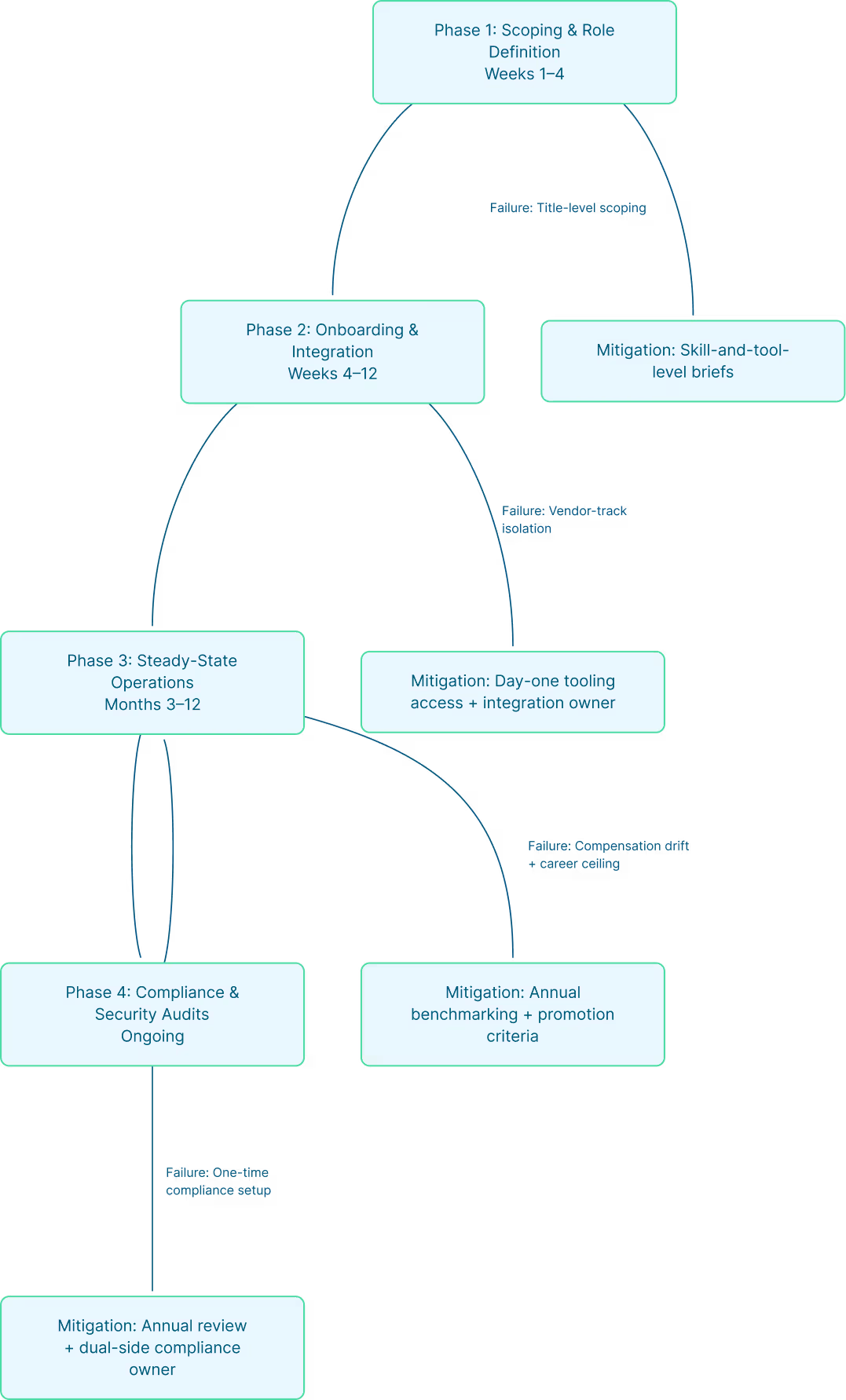
Phase 1: Scoping and Role Definition (Weeks 1–4)
Common scoping errors include treating L3 support as interchangeable with L1/L2, scoping QA roles without specifying manual vs. automated capability, or hiring generalist developers for specialized stack requirements. Define role requirements at the skill-and-tool level — specify frameworks, certifications, and stack experience in the job brief, not just the job title.
Phase 2: Onboarding and Integration (Weeks 4–12)
The most damaging onboarding failure is treating offshore staff as a separate vendor track rather than integrating them into core team workflows. Inadequate access provisioning — VPN, repo access, communication tools — in the first two weeks compounds the problem. Assign an onshore integration owner, provision all tooling access on day one, and include offshore staff in team rituals from week one.
Phase 3: Steady-State Operations (Months 3–12)
Compensation drift is the primary steady-state risk. The Philippine IT talent market moves; a rate that was competitive 18 months ago may be below market today. Career ceiling perception drives attrition of top performers. Mitigation requires annual compensation review against current local IT market conditions and explicit promotion criteria with documented career path progression.
Phase 4: Compliance and Security Audits (Ongoing)
Treating Data Processing Agreements (DPAs) and security controls as one-time setup items — rather than ongoing obligations — is the most common compliance failure mode. When the client’s own compliance posture changes (achieving SOC 2 Type II, entering a new regulated market), contractual frameworks must be updated accordingly. Build an annual compliance review into the engagement contract and assign a compliance owner on both sides.
Role Coverage: What You Can Actually Offshore
The Philippine IT-BPM talent pool covers the full engineering stack — not just generalist support roles.
Software Development
- Full-stack developers (React/Node, Django/Python, Ruby on Rails, Java Spring)
- Front-end engineers (React, Vue, Angular, TypeScript)
- Back-end engineers (APIs, microservices, database architecture)
- Mobile developers (iOS/Swift, Android/Kotlin, React Native, Flutter)
QA Engineering
- Manual QA — functional testing, regression testing, exploratory testing, UAT facilitation
- Automated QA — Selenium, Cypress, Playwright, WebdriverIO
- API testing — Postman, REST Assured
- Performance testing — k6, JMeter, Locust
- ISTQB-certified testers are common in the Philippine QA talent pool
DevOps and Cloud Infrastructure
- DevOps engineers — CI/CD pipeline management, containerization (Docker, Kubernetes), infrastructure-as-code (Terraform, Ansible)
- Cloud engineers — AWS Certified Solutions Architect, Google Cloud Professional certifications are widely held
- Security engineers — CompTIA Security+, Cisco CCNA, and SOC-adjacent roles
IT Helpdesk and Technical Support
- L1 support — ticket triage, password resets, basic troubleshooting, SLA-governed first response
- L2 support — application troubleshooting, escalation handling, user administration
- L3 support — infrastructure-level, code-adjacent, or vendor escalation management
L3 roles require deliberate senior talent sourcing. Treating L3 as interchangeable with L1/L2 is a common scoping error that produces support quality failures within the first quarter.
Time Zone Architecture: The UTC+8 Overlap Window
The Philippines operates at UTC+8, creating a 3–4 hour same-day overlap window with US West Coast business hours (UTC-7/UTC-8) — sufficient for daily standups, sprint ceremonies, synchronous incident response, real-time code review handoffs, and stakeholder demos.
For US East Coast teams (UTC-5), the overlap is minimal during standard hours, which pushes the model toward async-first workflows. This requires deliberate communication architecture: documented decision logs, async video updates, and clear escalation protocols for production incidents.
On-call and incident response obligations for L3 support and engineering roles must be explicitly negotiated and compensated. The most functional model for US-headquartered companies is a rotation structure that distributes on-call burden across onshore and offshore team members — not an assumption that offshore staff will absorb on-call burden without compensation and scheduling structure.
Key Benefits
Structural Cost Reduction Without Capability Compression
The math holds up on its own: a statutory load in the 12–15% range doesn’t come close to the 30–40%+ employer burden US companies budget for domestically. For a 10-person engineering team, that gap compounds into real money every single year.
Access to a Certified, Deep Talent Pool
The Philippine IT workforce holds internationally recognized certifications at scale — AWS Certified Solutions Architect, Google Cloud Professional, Certified Scrum Master (CSM), ISTQB, CompTIA Security+, and Cisco CCNA are standard hiring filters in the local market, not aspirational credentials. QA hiring managers will also recognize the certification landscape immediately — ISTQB shows up on resumes here at a rate that Western hiring managers often don’t expect from an offshore market.
English Proficiency as an Operational Differentiator
Two factors make this pool deeper than a typical low-cost market: English fluency that removes the documentation and stakeholder-communication friction other markets carry, and a government actively investing in keeping the pipeline current rather than letting it stagnate. Both are covered in more detail below — the short version is that the talent pool you’re hiring from today is being deliberately built, not just discovered.
Coverage Extension Without Overnight Shift Premiums
One e-commerce technology firm’s support model had an obvious gap: a small US-based team covering roughly 8 hours a day, with nothing but voicemail after that. They closed it by building an offshore L1/L2 team structured to hit an 18-hour coverage window, with ticket triage and password resets handled offshore and a clear handoff to a US-based L3 engineer whenever something touched infrastructure. The gap that used to sit open overnight simply stopped existing — tickets got a first response whether they came in at 2 PM or 2 AM, at a fraction of what a US overnight shift would have cost to staff.
Attrition Mitigation When Managed Proactively
Attrition is the most underweighted risk in offshore IT staffing evaluations — but it is manageable. The levers that work:
- Compensation benchmarking at hire and annually. The Philippine IT talent market moves; a rate competitive 18 months ago may be below market today.
- Explicit career pathing. Offshore developers who see a path from mid-level to senior to tech lead within the engagement stay longer. Those who see a permanent ceiling leave.
- HMO coverage as a retention signal. Health maintenance organization coverage is a standard expectation in Philippine IT employment. Providing it signals employer seriousness.
- Integration into the core team. Offshore staff treated as full team members — included in sprint retrospectives, credited in release notes, invited to team offsites when feasible — demonstrate materially lower attrition than those managed as a separate “offshore vendor.”
Government-Backed Talent Pipeline Development
The Department of Information and Communications Technology (DICT) runs active upskilling programs aligned to cloud computing, cybersecurity, and software engineering — including partnerships with coding bootcamps and university curriculum alignment. The talent pool is not static; it is being actively developed.
Costs & Pricing
Rate Cards vs. Total Cost of Engagement
Rate-card comparisons are operationally misleading. A headline offshore developer rate does not represent actual per-seat cost. Tech companies that model only the headline rate consistently underestimate total engagement cost by a meaningful margin.
The TCE Stack
Base Salary (monthly)
- Statutory Load (SSS, PhilHealth, Pag-IBIG, 13th month) → +12–15%
- Employer-Side Benefits (HMO, transportation, meal allowances) → +5–10% (varies)
- Infrastructure & Tooling (hardware, VPN, endpoint mgmt, collaboration licenses, secure workspace) → +5–15%
- Management Overhead (team lead time, onboarding, HR admin) → +3–8%
- Ramp-Time Productivity Loss (first 60–90 days) → variable ────────────────────────────────────────────────────────────── = Total Cost of Engagement (TCE)
In a composite engagement pattern observed frequently, infrastructure provisioning, security tooling, and ramp-time productivity loss added approximately 18–22% above the headline per-seat cost when modeled honestly. That figure still represented substantial savings against equivalent US-market fully loaded compensation — but it closed the gap meaningfully from the rate-card comparison.
Ramp-Time Productivity Loss: Model It Explicitly
For a developer joining a complex, established codebase, realistic full-productivity ramp time is typically 60–90 days with structured onboarding — and can extend to 120 days for highly complex or poorly documented systems. QA engineers joining an existing test suite typically ramp faster, often reaching meaningful productivity within 30–45 days if test documentation and environment access are provisioned promptly.
Treating a day-one hire as day-one full productivity is a common and costly planning error. Ramp-time productivity loss must be explicitly modeled in the TCE calculation.
Compliance and Security Setup Costs
SOC 2, ISO 27001, HIPAA, and PCI-DSS compliance can be maintained in offshore IT staffing arrangements — but only with explicit contractual obligations, documented security controls, and audit rights built into the engagement structure from day one. Retrofitting compliance requirements into an existing offshore engagement is significantly more expensive and disruptive than building them in at contract execution.
For regulated industries — healthcare technology (HIPAA), financial services (PCI-DSS, SOC 2), or enterprise SaaS with enterprise customer DPA obligations — compliance structuring adds legal and administrative cost upfront but eliminates the exposure that would otherwise make the engagement untenable for enterprise customers.
The Practical Floor
Budget for TCE, not rate cards. The companies that get burned are the ones that anchor to the headline number and treat everything else as a surprise. See offshore team pricing and engagement models for current per-seat cost ranges by role category.
Global Case Studies
Anonymized composite case studies based on engagement patterns observed across offshore IT staffing arrangements. No real named-firm incidents are depicted.
QA Augmentation at a Series A SaaS Company
A US-based SaaS startup with approximately 40 FTEs augmented its QA function with a 4-person offshore team in the Philippines. The team was integrated directly into the existing GitHub/Jira workflow, participating in sprint planning and daily standups via async video and a 30-minute synchronous overlap window. Regression cycle time compressed meaningfully, enabling a shift to continuous delivery without adding to the US headcount burn rate. The critical success factor: the offshore QA lead was given direct access to the engineering manager and treated as a peer, not a vendor contact.
L1/L2 Helpdesk Coverage Extension at a Mid-Market E-Commerce Technology Firm
A mid-market e-commerce technology firm built an offshore L1/L2 helpdesk team to extend support coverage to 18 hours per day. First-response time dropped significantly compared to the prior model, which relied on a small US-based team with no overnight coverage. The offshore team handled ticket triage, password resets, and application-level troubleshooting, with a documented escalation path to a US-based L3 engineer for infrastructure-level issues. The cost differential versus a US-based overnight shift was substantial — and the coverage quality was equivalent.
Automated Testing at a Fintech Startup
A fintech startup used offshore staff augmentation to build a dedicated automated testing function using Cypress and Playwright. The offshore SDET team achieved a QA-to-developer ratio closer to industry best practice — something the company could not staff domestically without significant salary pressure for senior SDET talent. The engagement required explicit PCI-DSS-aligned security controls and endpoint management, which added to setup cost but was non-negotiable given the company’s regulatory environment.
Blended Onshore/Offshore Model at a Digital Agency
A digital agency managing multiple client tech stacks used a blended model: senior architects and client-facing engineers onshore, mid-level developers and QA engineers offshore. The offshore team operated within the same tooling environment (GitHub, Jira, Figma, Slack) and was indistinguishable to clients from the onshore team in terms of communication quality and delivery output. Gross margin on delivery improved materially without any reduction in client-facing quality standards.
Philippines Relevance & Local Examples
Why the Philippines Specifically
The Philippines is not a cost play with talent as an afterthought. The structural advantages are specific and compounding.
Workforce depth. The Commission on Higher Education (CHED) reports sustained growth in computing and engineering enrollment. The pipeline of IT graduates entering the workforce annually is substantial and growing.
English proficiency. The Philippines consistently ranks among the highest globally for English proficiency in Asia — operationally significant for client-facing technical support and developer roles requiring documentation, code commenting, and stakeholder communication.
Government investment. The DICT runs active upskilling programs aligned to cloud computing, cybersecurity, and software engineering, including partnerships with coding bootcamps and university curriculum alignment. The talent pool is being actively developed.
Certification density. AWS Certified Solutions Architect, Google Cloud Professional, CSM, ISTQB, CompTIA Security+, and Cisco CCNA certifications are standard hiring filters in the local market — not aspirational credentials.
Geographic Hub Options
| Hub | Talent Pool Depth | Notes |
| Metro Manila (Makati, BGC, Ortigas, QC) | Deepest | Most mature IT-BPM infrastructure |
| Cebu City | Established secondary | Lower attrition in some role categories; competitive cost |
| Davao / Clark | Emerging | Narrower talent depth; specific functions only |
The Statutory Cost Structure
Philippine statutory employer obligations are bounded and transparent. SSS, PhilHealth, Pag-IBIG contributions, and 13th-month pay add approximately 12–15% above base salary. HMO coverage is a standard expectation in Philippine IT employment — providing it signals employer seriousness and functions as a meaningful retention lever.
Data Privacy Compliance: Republic Act 10173
Philippine offshore IT engagements involving personal data are governed by Republic Act 10173 (the Data Privacy Act of 2012). Any arrangement where offshore staff access, process, or store personal data belonging to the client’s customers requires:
- A Data Processing Agreement (DPA) between the client (Personal Information Controller) and the offshore provider or employer-of-record (Personal Information Processor)
- NPC-mandated PIP-PIC agreements where applicable
- Documented data handling procedures and breach notification protocols
For regulated industries, this layer is not optional and not boilerplate. A healthcare technology company in a composite engagement pattern structured its offshore IT staffing with explicit BAA-equivalent contractual obligations, endpoint management requirements, and annual security audit rights — adding legal and administrative cost upfront but eliminating the compliance exposure that would have made the engagement untenable for enterprise customers.
Intellectual Property Structuring Under Philippine Law
Work-for-hire clauses in Philippine employment contracts are the standard mechanism for IP assignment. Enforceability depends on proper drafting under Philippine labor law (the Labor Code, Presidential Decree No. 442), alignment with the client’s home jurisdiction IP requirements, and NDA coverage for all personnel with access to proprietary codebases or trade secrets. A standard US contractor NDA is not sufficient for a Philippine employment relationship — the legal structures are materially different. Engage counsel familiar with both jurisdictions.
Comparison Table
The table below compares the three primary staffing models across the dimensions most relevant to tech company decision-making.
| Factor | Pure Offshore (Philippines) | Nearshore (LATAM) | Onshore (US) |
| Fully loaded cost (developer) | Significantly lower | Moderate | Highest |
| Statutory employer load | ~12–15% above base | Varies by country | ~30–40%+ above base |
| English proficiency | High | Variable | Native |
| Time zone overlap (US West Coast) | 3–4 hrs same-day | Full overlap | Full overlap |
| Talent pool depth (IT) | Large, mature | Growing | Deep but expensive |
| Certification density | High | Moderate-high | High |
| Data privacy framework | RA 10173 / NPC | Varies by country | State/federal |
| Attrition risk (year 1) | Elevated if unmanaged | Moderate | Lower |
| IP enforceability | Requires dual-jurisdiction structuring | Varies | Strongest |
| On-call / incident response | Requires explicit shift design | Partial overlap advantage | Straightforward |
| Setup compliance cost | Higher (DPA, endpoint mgmt) | Moderate | Lower |
Reading the table: Nearshore (LATAM) offers full time zone overlap with the US, which is a genuine operational advantage for synchronous-heavy teams. The Philippines offers a deeper, more mature IT-BPM talent pool, higher certification density, and a more transparent statutory cost structure — at the cost of a narrower same-day overlap window and a more complex IP/compliance structuring requirement. Onshore remains the strongest option for IP enforceability and on-call simplicity, but at a cost structure that is difficult to sustain at scale for most growth-stage tech companies.
The right model depends on the function being staffed, the team’s async maturity, and the regulatory environment. Many tech companies operate blended models — onshore for senior architecture and client-facing roles, offshore for development capacity, QA, and helpdesk coverage extension.
Conclusion & Actionable Takeaway
The structural case for offshore IT staffing in the Philippines is grounded in a mature talent market, a bounded and transparent statutory cost structure, and a decade of remote-work normalization that has eliminated most of the integration friction that once made offshore engineering teams operationally difficult.
The companies that extract durable value from this model share three characteristics: they model total cost of engagement rather than rate cards, they integrate offshore staff as full team members rather than managing them as a vendor track, and they build compliance and IP structuring into the engagement from day one rather than retrofitting it after problems emerge.
The companies that fail do the opposite on all three counts — and then attribute the failure to “offshore quality” rather than to their own scoping and management decisions.
Tech companies that treat outsourcing as a structural workforce strategy — not a short-term cost fix — build the vendor governance, IP protection frameworks, and quality assurance pipelines needed to scale engineering capacity without proportional headcount growth. The companies that win long-term are those that standardize their outsourcing playbook early, retain institutional knowledge internally, and use offshore leverage to extend runway and compress time-to-market. The cost savings are real. But the operational leverage — the ability to scale engineering capacity, extend support coverage, and build specialized QA functions without US-market salary pressure — is the more durable strategic asset.
The actionable starting point: Define a pilot engagement — one team, one function, a 90-day integration milestone, and a TCE model built before the first hire. Expand from demonstrated results, not from projected savings. Use the onboarding checklist at Philippines data compliance and onboarding checklist to structure the pilot and the compliance framework at compliance and service structures guide to ensure the engagement is structurally sound from day one.
For a broader framework on building offshore staffing programs across business functions, see Staff Outsourcing for Small and Medium Businesses: The Complete Playbook.
FAQs
How should a US-based startup structure IP assignment and work-for-hire clauses in contracts with offshore developers to ensure full ownership under both US copyright law and the contractor’s local jurisdiction?
US-based clients must ensure that offshore employment contracts include explicit IP assignment language aligned to both Philippine labor law (the Labor Code, Presidential Decree No. 442) and US copyright law — a standard US contractor NDA applied to a Philippine employment relationship is not sufficient, as the legal structures are materially different. Work-for-hire clauses in Philippine employment contracts are the standard mechanism, but enforceability requires proper drafting under Philippine law, NDA coverage for all personnel with codebase access, and review by counsel familiar with both jurisdictions. Do not assume that IP assignment language drafted for a US W-2 or 1099 relationship transfers automatically to an offshore employer-of-record structure.
What SOC 2 Type II or ISO 27001 compliance requirements should a tech company impose on an IT outsourcing vendor handling access to production codebases or customer data?
SOC 2 compliance does not transfer automatically to an offshore engagement — it requires deliberate contractual and technical architecture. The engagement contract must explicitly assign SOC 2 control obligations to the offshore provider or employer-of-record, with documented endpoint management requirements (MDM enrollment, encrypted devices, VPN enforcement), audit rights, and incident response protocols. Endpoint management and access control documentation are the two most common gaps in offshore IT engagements that otherwise meet SOC 2 intent. For ISO 27001, the same principle applies: build the information security management obligations into the contract at execution, not after the first audit cycle. Retrofitting compliance requirements into an existing offshore engagement is significantly more expensive and disruptive than structuring them from day one.
How do you legally classify and manage outsourced offshore developers to avoid co-employment liability or permanent establishment tax risk in the vendor’s country?
The employer-of-record (EOR) model is the standard structural solution: the EOR is the legal employer in the Philippines, managing payroll, statutory contributions (SSS, PhilHealth, Pag-IBIG), and labor law compliance, while the client retains operational direction over the work. This structure, when properly documented, separates the employment relationship from the client’s operational control in a way that mitigates co-employment exposure. Permanent establishment (PE) risk arises when a foreign company’s offshore arrangement is structured in a way that creates a taxable presence in the Philippines — typically through fixed-place-of-business indicators or dependent agent relationships. Engage tax counsel familiar with Philippine Bureau of Internal Revenue (BIR) guidance and applicable tax treaty provisions before establishing any arrangement that involves dedicated office space, long-term contracts, or management authority exercised by the foreign client in-country.
What SLA metrics should be contractually defined when outsourcing QA functions to an offshore team?
At minimum, a QA outsourcing SLA should define: defect escape rate (the percentage of defects reaching production that were not caught in QA — a commonly used illustrative target is below a threshold agreed at contract execution), mean time to resolution (MTTR) for critical and high-severity defects, test coverage percentage for regression suites, sprint velocity expectations (story points completed per sprint, with a defined ramp period before performance expectations apply), and first-pass yield on test execution. Ramp-time productivity loss should be explicitly modeled — QA engineers joining an existing test suite typically reach meaningful productivity within 30–45 days if test documentation and environment access are provisioned promptly, but contractual performance expectations should not apply until after a defined ramp period (typically 30–45 days post-start). On-call and incident response obligations must be explicitly negotiated and compensated under Philippine labor law — they cannot be assumed as part of a standard offshore engagement.
Related Services & Next Steps
Explore OffshorePH’s Offshore IT Staffing Model
OffshorePH structures offshore IT staffing engagements for tech companies across the full engineering stack — developers, QA engineers, DevOps specialists, and technical support. Engagements are built on an employer-of-record model that handles Philippine statutory compliance, payroll, HR administration, and facilities, while the client retains full technical direction. Learn more
Review the Compliance Framework
For tech companies in regulated industries — healthcare technology (HIPAA), financial services (PCI-DSS, SOC 2), or enterprise SaaS — the compliance structuring layer is non-negotiable. OffshorePH’s compliance framework covers Data Processing Agreements, endpoint management requirements, audit rights, and IP assignment structuring.
See Pricing and Engagement Structures
Current per-seat cost ranges by role category, TCE modeling guidance, and engagement structure options are available on the pricing page.
Use the Onboarding Checklist
The onboarding checklist covers day-one tooling provisioning, integration owner assignment, compliance documentation, and 90-day milestone structure for pilot engagements. Access the onboarding checklist
Related Reading
- Staff Outsourcing for Small and Medium Businesses: The Complete Playbook — broader framework for offshore staffing programs across business functions, applicable to tech companies evaluating their first offshore engagement or expanding an existing program.
