
Scaling an offshore team from 10 to 100 employees is not a linear growth problem — it is a series of discrete organizational inflection points, each demanding a different management response. Operators who fail at offshore scaling typically do not fail on cost or talent. They fail on invisible infrastructure: span-of-control design, compliance formalization, and culture transmission. This playbook sequences the decisions, systems, and structural investments required to navigate each inflection point without losing organizational identity.
Anonymized composite case studies throughout are based on observed operator engagements across US-based SMBs scaling Philippine offshore operations. No real firm names or fabricated firm-specific metrics are used.

The Core Arbitrage Case — and Its Real Ceiling
Philippine offshore labor costs for knowledge-work roles — bookkeeping, data processing, customer support, back-office administration — typically run 60–75% below equivalent US fully-loaded compensation (illustrative, based on publicly observable wage differentials). This differential is driven by purchasing-power parity, not quality gaps. The Philippines produces a large annual cohort of college graduates, with accountancy, business, and IT programs consistently among the highest-enrollment disciplines, sustaining a deep and replenishable talent pipeline for BPO-oriented work.
English proficiency is a structural advantage. The Philippines ranks in the “High Proficiency” band among Asian nations on widely referenced English proficiency indices — a direct consequence of the country’s bilingual education system and decades of US-aligned business culture. For client-facing roles, this is not a marginal differentiator. It is the reason US operators consistently report that Philippine offshore staff require less accent-neutralization training than counterparts in other low-cost geographies.
The IT-BPM sector is one of the Philippines’ largest foreign-exchange earners, with multi-decade institutional maturity confirmed by publicly available macro benchmarks — not a nascent experiment, but a structural capability.
What the Arbitrage Does Not Cover
The cost savings are real. The hidden costs are also real, and operators who ignore them build fragile operations.
Statutory load adds 12–15% above base salary (illustrative, consistent with statutory schedules published by SSS, PhilHealth, and Pag-IBIG). Philippine employer obligations include SSS (Social Security System), PhilHealth, and Pag-IBIG (HDMF) contributions, plus the mandatory 13th-month pay under Presidential Decree No. 851. These are non-negotiable statutory requirements — not optional benefits. Budget them from day one.
Night-shift differentials add further cost for US-aligned schedules. Under Article 86 of the Philippine Labor Code, work performed between 10 PM and 6 AM carries a mandatory minimum 10% premium. Operators running US Eastern or Central time-aligned shifts will trigger this provision for a meaningful portion of their offshore workforce’s hours. Overtime and holiday pay rules apply on top.
First-year attrition is a structural cost, not an anomaly. Industry observers consistently note that voluntary attrition in Philippine BPO operations is elevated in the first 12 months relative to tenured cohorts. Replacing a trained offshore employee typically costs 50–150% of that employee’s annual salary when accounting for recruitment, onboarding, and productivity ramp — an illustrative range, but one that operators consistently validate in practice.
The net arbitrage, after statutory load, shift premiums, attrition replacement costs, and management overhead, is still substantial. But it is not 70%. Model it honestly.
The Three Inflection Points Where Offshore Scaling Breaks
Most operators encounter three predictable structural ruptures as they scale:
Inflection Point 1 — Span-of-Control Threshold (~15–20 FTEs). At 10–15 offshore employees, informal management works. At 18–20 FTEs, it breaks — not gradually, but abruptly. The US-based founder or operations lead loses simultaneous visibility into output quality, individual escalations, and time-off management. The fix is structural: a dedicated offshore team lead, promoted from within the existing cohort, with explicit authority over day-to-day supervision, quality review, and first-line HR issues.
Under DOLE Department Order No. 174, staff leasing arrangements — where the client exercises day-to-day supervision — carry specific employer-of-record implications and DOLE registration requirements. If operating under a managed-operations or seat-leasing model, confirm with your BPO partner how supervisory authority is documented. Misclassification of the supervisory relationship creates compliance exposure.
Inflection Point 2 — Compliance Inflection (~40–60 FTEs). Below 40 FTEs, many operators run offshore payroll, HR, and data governance informally. At 40–60 FTEs, this becomes untenable — and in regulated industries, it becomes a liability. The compliance stack that must be formalized by 50 FTEs spans data privacy (RA 10173 / NPC-mandated PIP-PIC agreements), healthcare data (HIPAA BAA obligations mirrored in offshore site SOPs), payment data (PCI-DSS documented controls), security audit readiness (SOC 2 Type II), and all Philippine statutory payroll obligations.
Inflection Point 3 — Culture-Systems Inflection (~80–100 FTEs). At 10–30 offshore employees, culture transmits informally through direct interaction. At 80–100 FTEs, informal culture transmission collapses. The founding team has no direct relationship with the majority of offshore staff. Tenured employees who carried the culture are now a minority. New cohorts are being onboarded by people who were themselves onboarded informally six months ago. Culture must be systematized before it needs to be systematized — not after attrition data forces the conversation.

How It Works
The Scaling Roadmap: Phase-by-Phase Execution
The playbook is organized into three phases, each mapped to an inflection point. The governing principle: build the management layer, the compliance stack, and the culture systems one phase ahead of where you currently are.
Offshore Scaling Phases — 10 to 100 FTEs
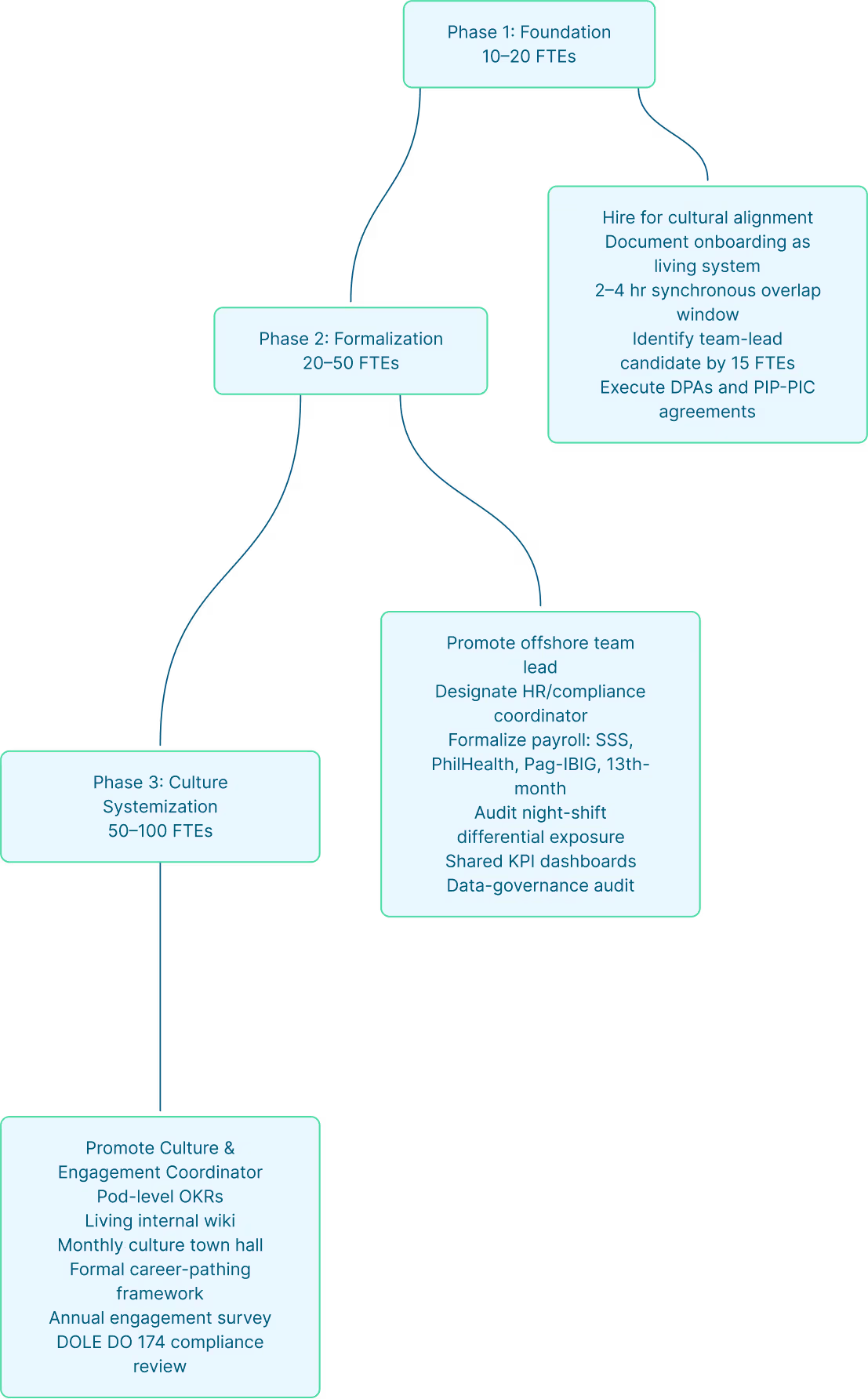
Phase 1: Foundation (10–20 FTEs)
The priority in this phase is establishing the structural habits that become load-bearing at scale. Onboarding must be documented as a living system — not a one-time packet — because the questions new hires ask repeatedly are the signal that documentation is missing. A 2–4 hour daily synchronous overlap window between US and Philippine teams is the single highest-leverage structural decision for cross-team cohesion. It preserves real-time collaboration without requiring full schedule inversion for offshore staff, a practice that drives attrition when sustained over months.
By 15 FTEs, identify the highest-performing offshore individual contributor and begin a structured transition into a team-lead role. Do not wait for the breakdown. The team-lead layer is not overhead — it is the load-bearing wall of the offshore operation.
Phase 2: Formalization (20–50 FTEs)
This phase formalizes what Phase 1 established informally. The offshore team lead receives explicit, documented authority over day-to-day supervision, quality review, and first-line HR issues. A dedicated HR/compliance coordinator — even at 0.5 FTE — is designated. Payroll systems are implemented with statutory calculation automation for SSS, PhilHealth, Pag-IBIG, and 13th-month pay. Night-shift differential exposure is audited and budgeted as a fixed cost component.
Shared KPI dashboards — visible to both onshore and offshore teams — are implemented. When offshore staff can see how their output connects to company-level objectives, and when US leadership can see offshore team performance in the same dashboard, accountability becomes shared rather than directional.
A formal data-governance audit against applicable frameworks (SOC 2, HIPAA/BAA, PCI-DSS) is conducted at 40 FTEs. The cost of a proactive audit is a fraction of one remediation sprint triggered by a client audit.
Phase 3: Culture Systemization (50–100 FTEs)
This phase converts informal culture into documented, ritually reinforced systems. The four mechanisms that work at this scale:
- Time-Zone Overlap Engineering. The mandatory 2–4 hour synchronous window, established in Phase 1, is maintained and protected. When offshore staff can ask a question and receive an answer in real time — not 16 hours later — they feel part of the operation, not adjacent to it.
- Shared OKRs and Visible KPI Dashboards. Pod-level OKRs aligned to company objectives, combined with a living internal wiki updated weekly with assigned ownership, substitute for informal culture transfer at scale. The wiki is not a static document — it is a maintained system.
- Structured Feedback Cycles. The minimum viable feedback architecture: monthly 1:1 between offshore employee and direct supervisor; quarterly performance review with documented ratings and development goals; annual career-pathing conversation with explicit promotion criteria. Offshore employees who receive structured feedback consistently show higher engagement and lower intent-to-leave than those managed solely through task-tracking tools.
- The Culture & Engagement Coordinator Role. At 40–50 FTEs, a high-performing offshore individual contributor is promoted into this role — even at 0.5 FTE. This person owns onboarding rituals, coordinates the monthly culture town hall, manages the buddy program for new hires, and serves as the early-warning system for engagement issues before they become attrition. The internal promotion signal itself carries culture value: it demonstrates that offshore careers have upward trajectory within the organization.
Phase Risk Analysis
| Phase | Most Common Failure Mode | Early Warning Signal | Corrective Action |
| Phase 1 (10–20 FTEs) | Onboarding treated as a one-time event | New hires ask the same questions repeatedly; no single source of truth | Convert onboarding packet to a living wiki with version control and assigned ownership |
| Phase 1–2 Transition | Team-lead promotion delayed past 20 FTEs | US manager fielding individual offshore escalations daily | Accelerate team-lead promotion; define authority scope in writing before handoff |
| Phase 2 (20–50 FTEs) | Statutory compliance managed informally | Payroll discrepancies; offshore staff raising benefits questions to US managers | Designate HR coordinator; implement payroll system with statutory calculation automation |
| Phase 2–3 Transition | Data governance gaps surface during client audit | Client requests documentation that does not exist | Conduct proactive compliance audit at 40 FTEs; do not wait for external trigger |
| Phase 3 (50–100 FTEs) | Culture transmission relies on informal carriers | Tenured offshore staff report feeling disconnected; new hires describe culture inconsistently | Launch structured culture-transmission mechanisms (wiki, OKRs, town halls) before attrition data forces it |
| Phase 3 | “Us vs. them” dynamic between onshore and offshore teams | Offshore staff excluded from product/strategy updates; US team refers to offshore as “the vendors” | Shared dashboards, joint OKRs, and US leadership participation in offshore town halls |

Key Benefits
Culture Control at Scale
Operators who build culture systems proactively — before attrition data forces the conversation — consistently achieve lower voluntary attrition in subsequent cohorts. The mechanisms are not complex: a mandatory synchronous overlap window, shared OKRs visible to both onshore and offshore teams, structured monthly feedback cycles, and a dedicated Culture & Engagement Coordinator promoted from within. Each mechanism is individually low-cost. Their compounding effect is the difference between a distributed team that functions as one organization and one that fractures into onshore and offshore factions.
Compliance Risk Elimination
Formalizing the compliance stack before an external trigger — a client audit, a DOLE inspection, an NPC inquiry — is structurally cheaper than remediating after the fact. The cost of a proactive data-governance audit at 40 FTEs is a fraction of a 90-day remediation sprint. The cost of designating a 0.5 FTE HR/compliance coordinator is a fraction of one payroll discrepancy dispute. Compliance formalization is not overhead — it is risk elimination at a known, manageable cost.
Predictable Unit Economics
Operators who model offshore labor costs honestly — including statutory load (12–15% above base salary, illustrative), night-shift differential exposure (10% minimum for US-aligned shifts), and attrition replacement costs (50–150% of annual salary, illustrative) — build operations with predictable unit economics. Operators who model only base salary build operations with recurring budget surprises. The arbitrage is real and substantial at 60–75% below US fully-loaded equivalents (illustrative). Honest modeling preserves that arbitrage rather than eroding it through unbudgeted cost events.
Scalable Management Architecture
The team-lead layer, established at 15 FTEs, becomes the management backbone of the operation at 50–100 FTEs. Pod-level team leads, each managing 10–15 offshore staff, allow US leadership to maintain strategic oversight without operational overload. This architecture scales; direct US-to-offshore management does not. Operators who build the team-lead layer early consistently report that the transition from 50 to 100 FTEs is operationally smoother than the transition from 10 to 50 — because the management infrastructure was built before it was needed.
Talent Depth and Replenishability
The Philippines’ BPO talent pipeline is structurally deep. Accountancy, business, and IT programs are consistently among the highest-enrollment disciplines at Philippine universities, producing a large annual cohort of qualified candidates for knowledge-work roles. English proficiency at the “High Proficiency” band among Asian nations means client-facing roles can be filled without the accent-neutralization training costs that other low-cost geographies require. For operators scaling to 100 FTEs, talent availability is not the binding constraint — management architecture is.

Costs & Pricing
Base Labor Cost
Philippine offshore labor costs for knowledge-work roles typically run 60–75% below equivalent US fully-loaded compensation (illustrative, based on publicly observable wage differentials). This is the headline arbitrage figure. It is real. It is also the starting point, not the ending point, of an honest cost model.
Statutory Employer Load
Philippine employer statutory obligations add approximately 12–15% above base salary (illustrative, consistent with statutory schedules). The components are non-negotiable:
- SSS (Social Security System): Employer contribution calculated on a monthly salary credit schedule
- PhilHealth: Premium contributions calculated on an income-based schedule
- Pag-IBIG (HDMF): Employer contribution registered and remitted monthly
- 13th-Month Pay: Mandatory under Presidential Decree No. 851; equivalent to one month’s base salary, paid by December 24 annually
Budget these from day one. They are not optional benefits — they are statutory obligations.
Night-Shift Differential
Under Article 86 of the Philippine Labor Code, work performed between 10 PM and 6 AM Philippine Standard Time carries a mandatory minimum 10% premium. US Eastern Time is 12–13 hours behind Philippine Standard Time (depending on US daylight saving). A Philippine employee working a standard US ET business day (9 AM–6 PM ET) is working approximately 9 PM–6 AM PST — triggering the night-shift differential for the majority of hours worked. Budget this as a fixed cost component, not an exception. Operators who model offshore labor costs without night-shift differential exposure systematically underestimate their Philippine payroll by a meaningful margin.
Attrition Replacement Cost
Replacing a trained offshore employee typically costs 50–150% of that employee’s annual salary when accounting for recruitment, onboarding, and productivity ramp (illustrative range, consistent with operator-reported experience). First-year attrition is elevated in Philippine BPO operations relative to tenured cohorts. The 0–90-day onboarding window is disproportionately high-stakes. This cost is not a one-time event — it recurs with every attrition event, which is why the Culture & Engagement Coordinator role and structured onboarding systems have a calculable ROI.
Management Overhead
The team-lead layer, HR/compliance coordinator, and Culture & Engagement Coordinator each carry a cost. These roles are not overhead in the pejorative sense — they are the infrastructure that makes the arbitrage sustainable. A composite cost model for a 50-FTE offshore operation should include:
- 2–3 offshore team leads (promoted from within; typically compensated at a modest premium above individual contributor rates)
- 0.5–1.0 FTE HR/compliance coordinator
- 0.5 FTE Culture & Engagement Coordinator (at the 40–50 FTE threshold)
Compliance and Legal Costs
Proactive compliance costs — DPA execution, NPC PIP-PIC agreement preparation, data-governance audit, DOLE DO 174 registration confirmation — are one-time or periodic investments. Reactive compliance costs — remediation sprints triggered by client audits or regulatory inquiries — can run significantly higher in management time and legal fees. The cost differential strongly favors proactive investment.
Global Case Studies
Composite Case Study 1: Accounting Practice — Span-of-Control Breakdown at 18 FTEs
A US-based accounting practice in the $8–20M revenue band scaled from a 12-person onshore team to a 60-person blended model over 24 months. The operation hit the span-of-control wall precisely at the 18-FTE mark. The founding partner was simultaneously fielding individual escalations from offshore staff, approving time-off requests manually, and losing visibility into output quality. The fix was structural: a dedicated offshore team lead, promoted from within the existing cohort, with explicit written authority over day-to-day supervision, quality review, and first-line HR issues. The transition stabilized the operation within one quarter and was identified as the enabling condition for subsequent scaling to 60 FTEs.
Lesson: Nobody budgets for a team lead until the founder is drowning in escalations. By then it’s already cost you a quarter of chaos you didn’t need to have. Watch the FTE count, not the symptoms.
Composite Case Study 2: Healthcare-Adjacent BPO Operator — Compliance Gap Surfaced by Client Audit at 55 FTEs
A healthcare-adjacent BPO operator discovered mid-scale, at approximately 55 FTEs, that its offshore site lacked documented HIPAA-equivalent controls. The gap surfaced during a client audit, not an internal review. The remediation sprint — 90 days to align Philippine data-handling procedures with Business Associate Agreement (BAA) obligations and NPC Data Processing Agreement requirements — cost significantly more in management time and legal fees than a proactive compliance build would have.
Lesson: This firm learned its compliance gap existed the worst possible way — from a client’s audit team, not its own. A scheduled internal review at 40 FTEs would have caught the same gap for a fraction of what the 90-day scramble ended up costing.
Composite Case Study 3: E-Commerce Operator — Culture Collapse at 80 FTEs
A mid-market e-commerce operator attempted to scale offshore customer support from 10 to 80 FTEs without a documented culture playbook. First-year attrition was elevated. Exit interviews surfaced a consistent theme: offshore staff felt disconnected from the company’s mission and uncertain about career trajectory. The operator rebuilt retention by introducing structured onboarding rituals, shared OKRs visible to both onshore and offshore teams, and a monthly culture town hall with US leadership. The following cohort showed meaningfully lower attrition.
Lesson: By the time exit interviews are telling you staff feel disconnected, you’re already paying for it in replacement costs. The fixes here — town halls, shared OKRs — aren’t complicated. What mattered was building them before the attrition numbers made it unavoidable.
Composite Case Study 4: Professional-Services Firm — Synchronous Overlap Engineering
A professional-services firm in the $5–15M revenue band implemented a mandatory 3-hour synchronous overlap window between its US leadership team and Philippine operations staff. Cross-team cohesion scores improved materially within two quarters. The mechanism is simple: when offshore staff can ask a question and receive an answer in real time — not 16 hours later — they feel part of the operation, not adjacent to it.
Lesson: Three hours of overlapping schedule time moved cohesion scores more than any culture initiative this firm tried afterward. It’s a scheduling decision, not a program — which is exactly why it’s easy to deprioritize and a mistake to.
Composite Case Study 5: Digital-Marketing Agency — Wiki as Culture-Transmission System
A digital-marketing agency that scaled from 10 to 100 offshore FTEs across three functional pods (creative, analytics, client services) used pod-level OKRs and a shared internal wiki as the primary culture-transmission mechanism. The wiki was not a static document — it was a living system, updated weekly, with ownership assigned to pod leads. Documentation systems, when maintained actively, can substitute for informal culture transfer at scale.
Lesson: A living wiki with assigned ownership is a culture-transmission system, not a documentation exercise. The distinction is maintenance cadence and accountability.
All case studies above are anonymized composites based on observed operator engagements. No real firm names or fabricated firm-specific metrics are used.
Philippines Relevance & Local Examples
Why the Philippines Is the Structural Choice for Knowledge-Work BPO
The Philippines is not a default offshore destination by accident. It is the product of multi-decade institutional investment in BPO-oriented education, infrastructure, and regulatory frameworks. The IT-BPM sector is one of the country’s largest foreign-exchange earners. The IT and Business Process Association of the Philippines (IBPAP) tracks sector headcount and revenue annually, providing publicly available macro benchmarks that confirm structural maturity.
English proficiency is a foundational structural advantage. The Philippines ranks in the “High Proficiency” band among Asian nations on widely referenced English proficiency indices — a direct consequence of the country’s bilingual education system and decades of US-aligned business culture. For client-facing roles, this is not a marginal differentiator.
The Philippine Statutory Framework: What Operators Must Know
The Philippine labor and data-privacy statutory framework is navigable — but only if operators engage with it proactively. The key obligations:
Payroll Statutory Obligations:
- SSS, PhilHealth, and Pag-IBIG contributions are mandatory employer obligations, not optional benefits
- 13th-month pay under Presidential Decree No. 851 is mandatory, equivalent to one month’s base salary, paid by December 24 annually
- Night-shift differential (minimum 10% for hours between 10 PM and 6 AM) under Article 86 of the Philippine Labor Code applies to the majority of hours worked on US-aligned shifts
- Overtime and holiday pay rules apply per Labor Code provisions
DOLE Compliance: Under DOLE Department Order No. 174, staff leasing arrangements require DOLE registration regardless of headcount. The registration obligation is triggered by the nature of the arrangement, not the size of the workforce. Misclassification of the supervisory relationship — particularly relevant as operators promote offshore team leads and Culture & Engagement Coordinators — creates compliance exposure that must be managed through documented role definitions.
Data Privacy — Republic Act 10173: The Philippines’ Data Privacy Act of 2012 (RA 10173) requires that offshore data processors execute Data Processing Agreements and, where applicable, PIP-PIC agreements overseen by the National Privacy Commission (NPC). The structural obligation is analogous to GDPR sub-processor requirements. If a US operation handles EU-resident data, the compliance chain extends through the Philippine processor — the obligation does not stop at the Philippine border. Operators in this position need DPAs that satisfy both RA 10173 and GDPR, which requires legal review by counsel familiar with both regimes.
The Philippine Compliance Stack: Consolidated Checklist
Philippine Statutory Obligations (Non-Negotiable):
- SSS employer contributions registered and current
- PhilHealth premium contributions calculated on income-based schedule
- Pag-IBIG (HDMF) contributions registered and remitted
- 13th-month pay budgeted and paid by December 24 annually (Presidential Decree No. 851)
- Night-shift differential (minimum 10% for 10 PM–6 AM hours) calculated and paid
- Overtime and holiday pay calculated per Labor Code provisions
- DOLE DO 174 registration confirmed if operating under staff leasing arrangement
Data Governance (US-Applicable Frameworks, Philippine Site Implementation):
- Data Processing Agreements (DPAs) executed with all Philippine data processors
- NPC-mandated PIP-PIC agreements in place where applicable (RA 10173)
- HIPAA Business Associate Agreements (BAAs) executed for healthcare-adjacent work
- PCI-DSS controls documented at offshore site level for payment-data roles
- SOC 2 Type II readiness assessment completed; gap remediation roadmap in place
- Offshore site data-handling SOPs documented and signed off by site lead
People Operations:
- Onboarding documentation converted to living system (version-controlled, owned)
- Monthly 1:1 cadence implemented for all offshore staff
- Quarterly performance review cycle in place with documented ratings
- Career-pathing framework documented with explicit promotion criteria
- Culture & Engagement Coordinator designated at 40–50 FTE threshold
- Annual engagement survey scheduled; action-response protocol defined
For a structured compliance framework reference, see compliance and service structures guide.
Comparison Table
Staffing Model Selection: Staff Leasing vs. Managed Operations vs. Pure Outsourcing
The model you choose has compliance, cost, and culture implications that compound as you scale. For operators scaling from 10 to 100 with culture preservation as a stated objective, staff leasing or managed operations is the appropriate model. Pure outsourcing transfers culture control to the partner — which is structurally incompatible with maintaining organizational identity across a blended workforce.
| Dimension | Staff Leasing (DO 174) | Managed Operations / Seat Leasing | Pure Outsourcing |
| Day-to-Day Supervision | Client exercises direct supervision | Shared; BPO partner provides infrastructure | BPO partner manages entirely |
| Employer-of-Record Liability | Client bears significant EOR exposure | Shared; depends on contract structure | BPO partner bears EOR liability |
| Culture Control | Highest — client manages culture directly | Moderate — client influences, partner executes | Lowest — culture is partner’s domain |
| Compliance Burden | Highest — client must ensure DOLE compliance | Moderate — partner handles statutory; client handles data governance | Lowest — partner handles most compliance |
| Cost Transparency | Highest — client sees all cost components | Moderate — some costs bundled | Lowest — output-based pricing obscures unit economics |
| Scalability | Moderate — management overhead scales with headcount | High — partner absorbs operational scaling | Highest — output scales without headcount management |
| Best Fit | Operators scaling 20–100 FTEs who want culture control | Operators scaling 50–200 FTEs who want infrastructure without full EOR exposure | Operators with well-defined, commoditized processes |
Compliance Domain Reference Table
| Compliance Domain | Specific Requirement | Philippine Analog |
| Data Privacy | Data Processing Agreements (DPAs) | NPC-mandated PIP-PIC agreements under RA 10173 |
| Healthcare Data | HIPAA BAA obligations | Mirrored in offshore site data-handling SOPs |
| Payment Data | PCI-DSS documented controls | Offshore site policy alignment required |
| Security Audit Readiness | SOC 2 Type II | Documented controls at offshore site level |
| Payroll & Benefits | SSS, PhilHealth, Pag-IBIG, 13th-month | Statutory — no discretion |
| Labor Classification | Staff leasing vs. outsourcing | DOLE DO 174 registration and documentation |
| Night-Shift Compliance | 10% NSD premium, overtime, holiday pay | Labor Code Article 86 |
Inflection Point Summary
| Inflection Point | FTE Threshold | Primary Risk | Required Action |
| Span-of-Control | ~15–20 FTEs | US manager overload; quality visibility loss | Promote offshore team lead with documented authority |
| Compliance Formalization | ~40–60 FTEs | Statutory payroll gaps; data-governance exposure | Designate HR/compliance coordinator; conduct data-governance audit |
| Culture-Systems | ~80–100 FTEs | Informal culture transmission collapses | Launch wiki, OKRs, town halls, and Culture & Engagement Coordinator before attrition forces it |
Conclusion & Actionable Takeaway
Scaling from 10 to 100 offshore employees is a governance problem disguised as a growth problem. The cost arbitrage is real and substantial — Philippine knowledge-work roles typically run 60–75% below US fully-loaded equivalents (illustrative, based on publicly observable wage differentials). But operators who treat offshore scaling as a cost exercise, rather than an organizational design exercise, consistently hit the same three walls: span-of-control breakdown at 15–20 FTEs, compliance exposure at 40–60 FTEs, and culture collapse at 80–100 FTEs.
The operators who scale successfully share one structural habit: they build the management layer, the compliance stack, and the culture systems one phase ahead of where they currently are. They promote the team lead before the breakdown. They conduct the compliance audit before the client audit. They launch the culture town hall before the attrition data forces it.
The Philippine offshore market offers genuine structural advantages — talent depth, English proficiency, statutory frameworks that are navigable with proper guidance, and a BPO sector with multi-decade institutional maturity. The operators who capture those advantages fully are the ones who treat offshore scaling as a systems-design challenge, not a headcount exercise.
The single most valuable action you can take today: Map your current operation against the three inflection points and identify which phase you are approaching. Then build the infrastructure for that phase now — not after you arrive.
- If you are at 10–15 FTEs: identify your team-lead candidate and begin the transition. Execute DPAs and PIP-PIC agreements now.
- If you are at 20–40 FTEs: designate your HR/compliance coordinator. Implement shared KPI dashboards. Audit night-shift differential exposure.
- If you are at 40–80 FTEs: conduct your data-governance audit. Promote your Culture & Engagement Coordinator. Launch pod-level OKRs and the monthly culture town hall.
For a structured assessment of your current offshore operation’s readiness to scale, see Philippines data compliance and onboarding checklist and the compliance and service structures guide.
FAQs
At what headcount does a Philippine offshore operation legally require a dedicated HR function, and what are the DOLE registration triggers?
Under DOLE Department Order No. 174, staff leasing arrangements require the contracting party to be registered with DOLE regardless of headcount — registration is triggered by the nature of the arrangement, not the size of the workforce. Practically, operators find that a dedicated HR function (even at 0.5 FTE) becomes operationally necessary at 40–50 FTEs, when payroll complexity, statutory remittance tracking, and employee relations issues exceed what a US-based manager can handle across time zones. The registration and compliance obligation, however, exists from the first hire under a covered arrangement.
How do NPC-mandated Data Processing Agreements differ from standard US vendor contracts, and what happens if a Philippine processor handles EU-resident data?
NPC-mandated PIP-PIC agreements under Republic Act 10173 govern the relationship between a foreign Personal Information Controller (PIC) and a Philippine-based Personal Information Processor (PIP). They require documented data-handling procedures, security controls, breach notification protocols, and audit rights — structurally analogous to GDPR Article 28 sub-processor agreements. If your Philippine processor handles EU-resident personal data, both RA 10173 and GDPR apply simultaneously. The compliance chain does not stop at the Philippine border. Operators in this position need DPAs that satisfy both frameworks, which requires legal review by counsel familiar with both regimes.
What is the correct way to calculate night-shift differential exposure when scheduling Philippine offshore staff on US Eastern Time alignment?
US Eastern Time (ET) is 12–13 hours behind Philippine Standard Time (PST), depending on US daylight saving. A Philippine employee working a standard US ET business day (9 AM–6 PM ET) is working approximately 9 PM–6 AM PST in standard time — triggering the 10% night-shift differential for all hours between 10 PM and 6 AM PST under Article 86 of the Philippine Labor Code. In practice, this means the majority of hours worked on a US ET-aligned shift qualify for the night-shift differential premium. Budget this as a fixed cost component, not an exception. Operators who model offshore labor costs without night-shift differential exposure systematically underestimate their Philippine payroll by a meaningful margin.
How should a US operator structure the Culture & Engagement Coordinator role to avoid DOLE misclassification risk under a staff leasing arrangement?
The Culture & Engagement Coordinator role should be documented as an internal employee support function — not a supervisory or managerial role that could trigger employer-of-record reclassification questions. Under DOLE DO 174, the critical distinction is whether the client exercises day-to-day control over the offshore workforce. A Culture & Engagement Coordinator who manages onboarding rituals, coordinates town halls, and tracks engagement metrics is performing a support function, not a supervisory one. The role’s job description should explicitly exclude disciplinary authority, performance rating authority, and hiring/termination decisions — those should remain with the designated team lead or the BPO partner’s HR function, depending on your model. Document this distinction in writing from the role’s inception.
Related Services & Next Steps
Assess Your Current Scaling Phase
Before selecting a staffing model or engagement structure, map your current operation against the three inflection points. The phase you are approaching — not the phase you are in — determines the infrastructure you need to build now. Use the onboarding checklist to identify gaps in your current documentation, feedback, and compliance systems: Philippines data compliance and onboarding checklist.
Review the Compliance Framework
If you are at or approaching 40 FTEs, a structured compliance review against Philippine statutory obligations (SSS, PhilHealth, Pag-IBIG, 13th-month pay, night-shift differential, DOLE DO 174) and applicable US frameworks (HIPAA, PCI-DSS, SOC 2) is the highest-priority action. The compliance framework reference provides a structured starting point: compliance and service structures guide.
Explore Engagement Models and Pricing
The staffing model you choose — staff leasing, managed operations, or pure outsourcing — has compounding implications for culture control, compliance burden, and cost transparency as you scale. For a detailed breakdown of engagement models and current pricing structures, see offshore team pricing and engagement models.
Start the Conversation
If you are currently at 10–30 FTEs and planning to scale to 100, the structural decisions you make in the next 90 days will determine whether the next phase of scaling is smooth or disruptive. OffshorePH works with US-based operators across the 10–100 FTE scaling range, providing employer-of-record infrastructure, compliance support, and culture-integration frameworks designed for the specific inflection points this playbook describes. Visit OffshorePH to begin the assessment.
