
A US SMB owner eliminates a single in-house bookkeeper position — with its fully-loaded cost burden, turnover exposure, and single-point-of-failure risk — and replaces it with a dedicated, Philippines-based finance team operating inside the same cloud accounting stack, under a structured service-level agreement, at a materially lower total cost. Named professionals are assigned exclusively to one client: no shared queues, no context-switching. The offshore team learns your chart of accounts, your vendor relationships, and your close calendar. Institutional knowledge compounds over time.
Three structural drivers behind this shift: a persistent US labor-cost burden that small businesses cannot absorb at scale, a Philippine talent pipeline producing CPA-licensed professionals in volume, and cloud accounting infrastructure that makes physical location operationally irrelevant.
Why This Is Not Legacy Outsourcing
This model assigns named professionals — a bookkeeper, a senior accountant, or both — exclusively to one client. There are no shared pools and no faceless queues. The dedicated model is operationally closer to an embedded hire than to a traditional outsourcing arrangement, with the critical difference that the provider absorbs turnover risk, HR administration, and statutory compliance obligations on the Philippine side.
The US Labor-Cost Problem
The salary line on a job offer is the smallest part of the problem. A US-based bookkeeper in a mid-tier metro market commands a base salary that, when layered with employer-side FICA contributions, state unemployment insurance, health insurance premiums, paid time off accrual, 401(k) matching, and office overhead, produces a fully-loaded annual cost that can reach $55,000–$85,000+ per year (illustrative) — and higher in coastal markets. For a business generating $3M–$8M in annual revenue, that single headcount represents a meaningful percentage of operating overhead. And it buys you one person who calls in sick, and one person who resigns three weeks before your tax deadline.
The Philippine Talent Pipeline
The Professional Regulation Commission (PRC) administers the CPA Licensure Examination twice annually. The Philippines produces tens of thousands of active licensed CPAs, with a continuous annual cohort of new passers entering the workforce. For offshore finance roles, this means the hiring floor is frequently a four-year BSA (Bachelor of Science in Accountancy) graduate — often CPA-licensed — working in a role that would be staffed by a non-credentialed clerk in the US market.
Under Article XIV, Section 7 of the 1987 Philippine Constitution, English is an official language of instruction and communication. Finance professionals draft financial memos, communicate with US clients via email and video call, and interpret GAAP guidance in English without translation friction. The adjustment for US SMB owners is in time zone and process documentation — not in language comprehension.
The IT-BPM Infrastructure
The Philippines’ IT-BPM (Information Technology and Business Process Management) sector has built finance and accounting process outsourcing into a strategic national growth pillar. The supporting infrastructure exists: fiber-redundant office environments, established HR pipelines, provider-side compliance frameworks, and a workforce culturally acclimated to serving US, Australian, and UK clients across finance functions.
What to Offshore and What to Keep In-House
Not every finance function belongs offshore on day one. The sequencing matters.
High-fit functions for offshore execution (Day 1–90):
- Accounts payable processing and vendor payment scheduling
- Accounts receivable invoicing and collections follow-up
- Bank and credit card reconciliation
- Payroll data entry and reconciliation (not payroll tax filing strategy)
- Expense report processing
- Month-end close transaction coding and workpaper preparation
Functions requiring US-side oversight or hybrid execution:
- Payroll tax filing and compliance (state-specific; requires US-side sign-off)
- Tax return preparation (CPA-licensed US preparer retains responsibility)
- Banking relationship management and wire authorization
- Lender covenant compliance and financial covenant certification
- Strategic financial planning and forecasting
The offshore team executes. The US-side controller, CPA, or owner reviews and approves. This division of labor is the correct governance structure for any finance function, onshore or offshore.
How It Works
The engagement moves through four structured phases. The 60–120 day adjustment window is not a flaw in the model — it is the cost of converting tribal knowledge into documented, transferable process, a one-time investment that makes the business more resilient regardless of who executes the work.
Philippines-Based Finance Team Engagement Phases
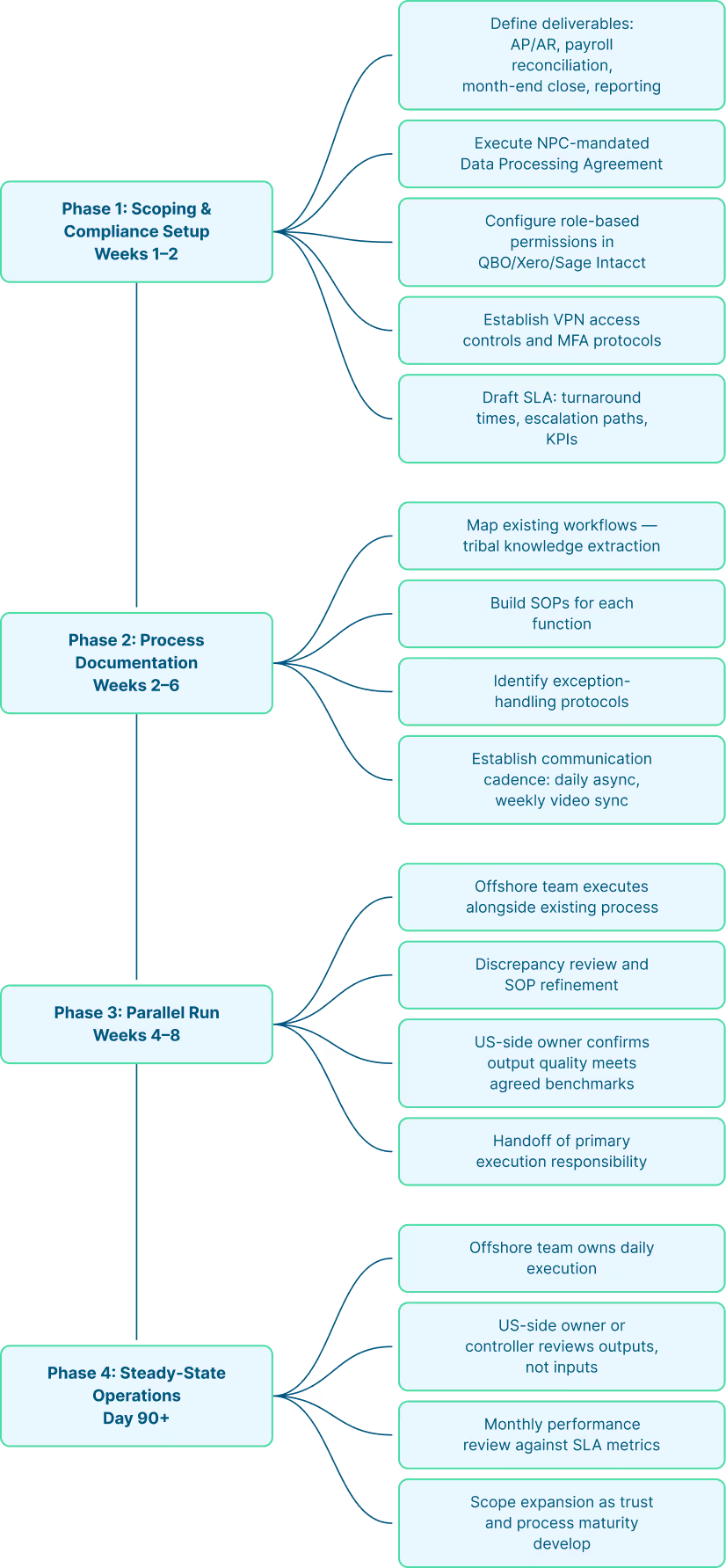
Phase 1: Scoping & Compliance Setup (Weeks 1–2)
This phase establishes the legal and operational foundation. Deliverables are defined — AP/AR, payroll reconciliation, month-end close, financial outputs — and the NPC-mandated Data Processing Agreement (DPA) is executed before any data access is granted. Role-based permissions are configured in QuickBooks Online, Xero, or Sage Intacct. VPN access controls and MFA protocols are established. The SLA is drafted with explicit turnaround times, escalation paths, and KPIs.
Phase 2: Process Documentation (Weeks 2–6)
US SMBs that have operated with a single in-house bookkeeper for years frequently discover that their “process” exists entirely in one person’s head. This phase extracts that tribal knowledge and converts it into standard operating procedures (SOPs) for each function, exception-handling protocols, and a defined communication cadence — daily async updates and weekly video syncs. Firms that resist this step extend the onboarding timeline and blame the offshore team for errors that are actually the result of undocumented exceptions.
Phase 3: Parallel Run (Weeks 4–8)
The offshore team executes alongside the existing process. Discrepancies are reviewed, and SOPs are refined. The US-side owner or designated reviewer confirms that output quality meets the benchmarks defined in the SLA before primary execution responsibility is handed off. This phase is where the SLA becomes operational rather than theoretical.
Phase 4: Steady-State Operations (Day 90+)
The offshore team owns daily execution. The US-side owner or controller reviews outputs, not inputs. Monthly performance reviews are conducted against SLA metrics. Scope expands as trust and process maturity develop.
Where Engagements Break Down
Scope creep without SLA guardrails: The most common failure mode is not skill gaps on the offshore side. It is an undefined scope that expands informally — the offshore team absorbs ad hoc requests, the SLA becomes meaningless, and accountability dissolves. A well-structured SLA specifying deliverables, turnaround times, revision cycles, and escalation paths is not optional.
Data compliance gaps: Offshore finance teams handle sensitive financial data: payroll records, vendor banking details, client invoices, tax workpapers. US SMB owners who skip the DPA step are creating liability exposure on their own side. For medical-adjacent businesses, HIPAA-aligned data handling protocols must be negotiated explicitly at engagement start.
Time zone misalignment: The Philippines operates at UTC+8. US Eastern time is UTC-5 (or UTC-4 during daylight saving) — a 12–13 hour gap. Many Manila-based teams work mid-shift or night-shift hours to overlap with US business hours, but this requires explicit scheduling agreement. Assuming real-time availability without confirming shift structure is a recurring source of early-engagement friction.
Single-provider dependency: Engaging a dedicated offshore team through a managed provider transfers turnover risk from the SMB to the provider — but does not eliminate it. Evaluating provider HR infrastructure, bench depth, and replacement SLAs before signing is due diligence, not paranoia.
Key Benefits
Credential Depth Above US Market Equivalents
The hiring floor for Philippines-based finance roles is frequently a four-year BSA graduate, often CPA-licensed — working in a role that would be staffed by a non-credentialed clerk in the US market. Operators gain access to a deeper credential stack at a lower cost point than domestic hiring allows.
Elimination of Single-Point-of-Failure Risk
A single US in-house bookkeeper is a single point of failure: one resignation, one illness, one February departure before tax season. A dedicated offshore team — backed by a provider with bench depth — distributes that risk. Provider-side HR absorbs turnover exposure that would otherwise fall entirely on the SMB owner.
Forced Process Documentation as a Structural Asset
The offshore transition forces documentation of workflows that previously existed only in one person’s head. This is painful in the short term and structurally valuable in the long term. A business whose finance processes are documented in SOPs is more resilient, more auditable, and more transferable than one whose operations depend on institutional memory held by a single employee.
Scalability Without the Hire-Fire Cycle
Adding a role within an existing provider relationship is operationally simpler than a US domestic hire — no job posting, no interview cycle, no 90-day notice period. The dedicated model scales up (and down) within the provider relationship, without the friction of US headcount management.
More Current Financial Visibility Replacing Lagged Summaries
Composite patterns in this market consistently show US SMB owners shifting from reviewing historical summaries to reviewing current financial data on a more frequent basis. Daily accounts receivable aging reviews, daily sales reconciliation, and morning-delivery variance flags replace weekly or bi-weekly manual pulls — changing the owner’s role from historian to decision-maker.
Coverage Continuity Across US Holidays and Absences
Provider bench scheduling eliminates the coverage gaps that a single in-house hire creates around US holidays, PTO, and unplanned absences. The offshore team’s schedule is managed at the provider level, not the SMB level.
Costs & Pricing
The Fully-Loaded US In-House Cost
A US-based bookkeeper in a mid-tier metro market, when layered with employer-side FICA contributions, state unemployment insurance, health insurance premiums, paid time off accrual, 401(k) matching, and office overhead, produces a fully-loaded annual cost that can reach $55,000–$85,000+ per year (illustrative) — and higher in coastal markets like New York, San Francisco, or Boston. These figures are illustrative, consistent with general US occupational wage observations for bookkeeping roles combined with standard US employer benefit burden estimates.
For a business generating $3M–$8M in annual revenue, that single headcount represents a meaningful percentage of operating overhead.
The Philippine Cost Structure
Philippine employer statutory contributions — SSS (Social Security System), PhilHealth, and Pag-IBIG (Home Development Mutual Fund) — run in the 12–15% band above base salary on the employer side (illustrative, consistent with Philippine statutory schedules). That is the mandatory statutory load. It is structurally different from US FICA plus benefits by design.
The peso-to-dollar exchange rate differential amplifies this further. A fully-loaded Philippines-based bookkeeper or staff accountant — including statutory contributions, a standard 13th-month pay obligation, and provider management overhead — typically costs a fraction of the US equivalent. Operators in this space commonly observe total cost savings in the 50–70% range (illustrative) relative to a comparable US in-house hire, though actual figures vary by role seniority, provider model, and specific market conditions.
The ceiling: A two-person Philippines-based team (bookkeeper plus senior accountant) can often be engaged for less than the fully-loaded cost of a single mid-market US bookkeeper.
The floor: That savings figure assumes a well-structured engagement. Poorly scoped SLAs, inadequate process documentation, and underestimated onboarding timelines erode the arbitrage. The savings are real — but they are not automatic.
13th-Month Pay and Statutory Obligations
Philippine law mandates 13th-month pay for rank-and-file employees — equivalent to one month’s base salary, payable by December 24 each year. This is a statutory obligation, not a discretionary bonus. It must be factored into total compensation modeling at engagement start.
If the engagement is structured as a direct hire rather than through a managed provider, Philippine employer-of-record obligations include SSS, PhilHealth, and Pag-IBIG contributions. Providers operating employer-of-record models absorb this obligation; direct-hire arrangements require the US SMB (or its Philippine entity) to manage it directly.
Provider Model vs. Direct Hire
| Cost Component | Managed Provider Model | Direct Hire (Philippine Entity) |
| Statutory contributions (SSS, PhilHealth, Pag-IBIG) | Absorbed by provider | SMB or Philippine entity manages directly |
| 13th-month pay | Absorbed by provider | SMB or Philippine entity manages directly |
| HR administration and bench depth | Provider-side | SMB-side |
| Turnover replacement | Provider SLA | SMB recruits and rehires |
| Compliance framework (DPA, NPC) | Provider-assisted | SMB constructs independently |
| Management overhead | Lower (provider handles) | Higher (SMB handles) |
For most US SMBs in the $1M–$20M revenue band, the managed provider model produces a lower total cost of ownership when HR administration, compliance, and turnover replacement costs are included — even if the headline rate appears higher than a direct-hire salary.
Global Case Studies
Anonymized composite case studies are illustrative constructs based on common engagement patterns in the Philippines offshore finance staffing market. They do not represent specific named firms or clients.
Composite A: E-Commerce Retailer, ~$4M Revenue
A US-based e-commerce operator running approximately $4M in annual revenue had a single in-house bookkeeper managing AP, AR, inventory reconciliation, and monthly close. When that bookkeeper resigned in Q4, the owner spent six weeks recruiting, lost institutional knowledge on three vendor payment workflows, and missed a month-end close deadline that delayed the delivery of a lender covenant compliance package to their banking contact.
The replacement decision: A two-person dedicated Philippines-based team — a bookkeeper handling daily transaction processing and a senior accountant managing month-end close and financial output delivery. The fully-loaded cost of the two-person offshore team came in below the fully-loaded cost of the single US hire they had just lost.
The onboarding reality: The 90-day onboarding period was primarily consumed by documenting the vendor payment workflows that had previously existed only in the departed bookkeeper’s memory.
Steady-state outcome: Month-end close compressed from 12 business days to 6 (illustrative). Daily accounts receivable aging reviews replaced weekly manual pulls. US holiday coverage gaps were eliminated through provider bench scheduling.
Composite B: Professional Services Firm, ~$9M Revenue
A regional consulting firm at approximately $9M revenue had a bookkeeper-plus-part-time-CPA-contractor model that functioned adequately until the bookkeeper departed and the CPA contractor reduced availability. The transition to a dedicated offshore team was used deliberately to force process documentation — the firm’s managing partner described it as “the most painful and most valuable thing we did in five years of operations.”
Key finding: The offshore senior accountant identified three recurring reconciliation errors in the firm’s historical books within the first 60 days — errors that had been masked by manual workarounds the departed bookkeeper had never documented.
Composite C: Multi-Location Restaurant Group, Six Locations
A restaurant group operating six locations had a single bookkeeper producing weekly financial summaries that consistently lagged by 10–14 days (illustrative) — too slow to catch food-cost variances before they compounded.
The transition: A dedicated offshore team enabled daily sales reconciliation across all six locations, with food-cost variance flags delivered by 9 AM US Central time each morning. The offshore team operated on a mid-shift schedule aligned to US Central morning hours, structured explicitly to ensure those morning deliveries.
Behavioral shift: The US-side owner moved from reviewing historical summaries to reviewing current financial data daily — shifting from historian to decision-maker.
Common Patterns Across Composites
Across these composite patterns, three consistent themes emerge:
- The triggering event is usually a departure, not a proactive decision. The offshore transition is reactive in origin but strategic in execution.
- The onboarding period surfaces hidden process debt. Tribal knowledge that appeared to be a “process” turns out to be undocumented exceptions held in one person’s memory.
- Steady-state reporting velocity increases materially. The shift from lagged summaries to more frequent, current financial data changes how owners interact with their financial information.
Philippines Relevance & Local Examples
The Philippine CPA Pipeline
The Professional Regulation Commission (PRC) administers the CPA Licensure Examination twice annually, producing a continuous annual cohort of new passers entering the workforce across hundreds of CHED-accredited accountancy programs. This is not a thin talent pool being stretched across competing demand — it is a structured, credentialed pipeline with institutional depth.
For offshore finance roles, this means the credential floor is frequently a BSA graduate with CPA licensure, not a non-credentialed clerk. US SMB owners gain access to a deeper credential stack than domestic hiring at equivalent cost allows.
English as an Operational Language
Under Article XIV, Section 7 of the 1987 Philippine Constitution, English is an official language of instruction and communication. Finance professionals in the Philippines draft financial memos, communicate with US clients via email and video call, and interpret GAAP guidance in English without translation friction. The operational adjustment for US SMB owners is in time zone and process documentation — not in language comprehension.
The IT-BPM Sector as Infrastructure
The Philippines’ IT-BPM sector — coordinated through IBPAP (IT & Business Process Association of the Philippines) — has built finance and accounting process outsourcing into a strategic national growth pillar. The supporting infrastructure exists at scale: fiber-redundant office environments, established HR pipelines, provider-side compliance frameworks, and a workforce culturally acclimated to serving US, Australian, and UK clients across finance functions.
Philippine Data Privacy Act Compliance Architecture
Under the Philippine Data Privacy Act of 2012 (Republic Act 10173) and NPC advisory guidance, any arrangement where a Philippine-based team processes personal or financial data on behalf of a foreign entity requires a Data Processing Agreement (DPA) executed between the data controller (US SMB) and the data processor (offshore provider or individual). This agreement must specify:
- The categories of personal data being processed
- The purpose and legal basis for processing
- Data retention periods and deletion protocols
- Security measures and breach notification obligations
- Sub-processor restrictions
NPC enforcement actions against non-compliant processors are documented. US SMB owners who treat the DPA as boilerplate rather than a substantive operational document are creating exposure on both sides of the engagement.
NPC-mandated Privacy Impact Assessments (PIAs) apply in higher-risk data handling contexts. For medical-adjacent businesses, HIPAA-aligned data handling protocols must be negotiated explicitly at engagement start — the offshore provider’s compliance framework does not automatically extend to US healthcare privacy requirements.
Statutory Employer Contributions
Philippine employer statutory contributions — SSS, PhilHealth, and Pag-IBIG — run in the 12–15% band above base salary on the employer side (illustrative, consistent with Philippine statutory schedules). These are hard-coded statutory obligations that do not vary by negotiation. The 13th-month pay obligation — one month’s base salary, payable by December 24 — is equally non-negotiable and must be factored into total compensation modeling at engagement start.
Time Zone Alignment
The Philippines operates at UTC+8. US Eastern time is UTC-5 (or UTC-4 during daylight saving) — a 12–13 hour gap. Many Manila-based teams work mid-shift or night-shift hours to overlap with US business hours. The restaurant group composite above illustrates this: the offshore team operated on a mid-shift schedule structured to deliver daily financial outputs by 9 AM US Central time. Explicit shift-structure agreement at engagement start is required; assumed real-time availability is a recurring source of early-engagement friction.
Comparison Table
| Dimension | US In-House Bookkeeper | Dedicated Philippines-Based Team |
| Fully-loaded annual cost | $55,000–$85,000+ (illustrative) | Materially lower; varies by role mix and provider |
| Statutory employer burden | FICA + state UI + benefits (~25–35% above base, illustrative) | SSS + PhilHealth + Pag-IBIG (~12–15% above base) |
| Talent credential floor | Often AA or BA, non-CPA | Frequently BSA graduate; CPA licensure common |
| Coverage during US holidays | Single point of failure | Provider bench depth; team continuity |
| Turnover risk absorption | Fully borne by SMB owner | Partially absorbed by provider-side HR |
| Process documentation | Often tribal knowledge | Structured SLA forces documentation at engagement start |
| Software environment | QuickBooks Online, Xero, Sage Intacct | Same platforms, browser-accessible; no physical dependency |
| Data compliance framework | US-side controls only | Philippine Data Privacy Act (RA 10173) + NPC-mandated DPAs |
| Onboarding timeline to steady-state | 2–4 weeks (familiar environment) | 60–120 days (process documentation phase) |
| Scalability | Hire/fire cycle; slow to scale | Add roles within existing provider relationship |
| 13th-month pay obligation | Not applicable | Statutory; must be modeled at engagement start |
| Language of operation | English | English (constitutional official language) |
| Time zone overlap with US | Full overlap | Requires explicit shift-structure agreement |
| Reporting velocity (typical steady-state) | Weekly or bi-weekly summaries common | Daily financial outputs achievable |
Conclusion & Actionable Takeaway
The replacement of a single US in-house bookkeeper with a dedicated Philippines-based finance team is not a cost-cutting tactic. It is a structural upgrade — more coverage, deeper credentials, documented processes, and a scalable model that grows with the business without the hire-fire cycle of US headcount management.
The financial arbitrage is real and material. The compliance requirements are non-negotiable and manageable. The onboarding friction is predictable and finite.
The Decision Framework
For US SMB owners in the $1M–$20M revenue band, the decision framework is straightforward:
- Calculate your fully-loaded in-house cost — salary plus FICA, benefits, PTO, overhead. The number is larger than the salary line suggests.
- Map your current finance function scope — identify which functions are high-fit for offshore execution on day one versus which require US-side oversight.
- Identify your data compliance obligations — execute an NPC-compliant DPA before any data access is granted. For medical-adjacent businesses, layer HIPAA-aligned protocols explicitly.
- Evaluate provider infrastructure — bench depth, replacement SLAs, compliance framework, and shift-structure options before signing.
- Budget the onboarding investment — the 60–120 day process documentation phase is not overhead. It is the price of building a finance operation that does not collapse when one person resigns.
The 60–120 day onboarding investment is the price of building a finance operation that does not collapse when one person resigns.
Explore OffshorePH’s dedicated Philippines-based finance team model | Review our compliance framework
FAQs
Can a Philippines-based bookkeeper handle US state-specific sales tax compliance and filing?
Transaction-level data entry and reconciliation — yes, routinely. Actual filing and compliance sign-off for US state sales tax obligations requires a US-licensed CPA or tax professional who retains legal responsibility for the filing. The offshore team prepares the workpapers; the US-side preparer reviews, approves, and submits. This division is both operationally sound and professionally required.
What happens to our data if the offshore provider relationship terminates?
This is precisely what the NPC-mandated Data Processing Agreement must address before engagement starts — not after termination. The DPA should specify data return protocols (format, timeline), certified deletion of retained copies, and sub-processor data handling obligations. Providers who cannot produce a compliant DPA with explicit termination data-handling clauses are a compliance risk regardless of their operational quality.
Is a dedicated offshore model appropriate for a business with fewer than $1M in annual revenue?
At sub-$1M revenue, transaction volume may not justify a full-time dedicated offshore hire. A fractional or part-time offshore bookkeeper — or a shared-model arrangement — is often more cost-appropriate at that stage. The dedicated model’s structural advantages (deep client knowledge, no context-switching, SLA accountability) compound most effectively when transaction volume and financial complexity justify full-time allocation.
How do we handle multi-factor authentication and access controls for a remote finance team operating in a different country?
Role-based permissions within QuickBooks Online, Xero, or Sage Intacct should be configured before the offshore team’s first login — limiting access to only the functions and data sets required for their defined scope. MFA should be mandatory for all accounting platform access. VPN requirements depend on the sensitivity of the data environment and the provider’s network infrastructure. These controls are not offshore-specific; they are standard remote-access governance that applies equally to any remote finance team, domestic or international. Document the access control architecture in the SLA and review it at each annual engagement renewal.
Related Services & Next Steps
Dedicated Finance Team Staffing
OffshorePH places named, dedicated Philippines-based bookkeepers and senior accountants exclusively with individual US SMB clients — no shared queues, no context-switching. Engagements are structured under SLAs with defined deliverables, turnaround times, and escalation paths.
Explore the dedicated finance team model
Compliance Framework and DPA Execution
Every OffshorePH engagement begins with an NPC-compliant Data Processing Agreement executed before any data access is granted. The compliance framework covers Philippine Data Privacy Act (RA 10173) requirements, role-based access controls, MFA protocols, and data retention and deletion policies.
Review the compliance framework
Onboarding Checklist
Budget the onboarding investment — the 60–120 day process documentation phase is not overhead. It is the price of building a finance operation that does not collapse when one person resigns.
Access the onboarding checklist
Pricing Structures
Pricing varies by role seniority, team composition (single bookkeeper vs. bookkeeper-plus-senior-accountant), and provider model (managed provider vs. direct hire). Illustrative cost savings in the 50–70% range relative to a comparable US in-house hire are operator-observed and vary by engagement structure.
Next Steps
- Calculate your fully-loaded in-house bookkeeper cost using the framework in the Costs & Pricing section above.
- Map your current finance function scope against the high-fit and hybrid-execution categories in the Detailed Explanation section.
- Contact OffshorePH to discuss role configuration, SLA structure, and compliance framework for your specific revenue band and industry.
