
Remote staffing is a structured employment model in which a US-based client firm directs the daily work of an offshore employee while a local staffing provider handles payroll, statutory compliance, HR administration, and benefits. The client owns the workflow; the provider owns the employment relationship. Unlike traditional outsourcing — where a vendor delivers a defined output — remote staffing embeds the offshore professional as a direct team member, with the client selecting, training, and managing them to firm standards.
Remote staffing is not outsourcing with a different label. The structural distinction is operational and consequential.
In traditional outsourcing, a vendor delivers a defined output — a processed batch, a completed return, a resolved ticket. The client has no visibility into who does the work or how. In remote staffing, the client selects the individual, trains them to firm standards, integrates them into internal systems, and manages their performance directly. The offshore employee functions as an embedded team member — not a vendor resource.
This structural difference shifts both the risk profile and the upside potential. It also shifts compliance obligations squarely onto the client’s desk.
Why US Professional Services Firms Are Moving Offshore Now
US labor costs in professional and business services have risen materially over the past several years. Bookkeepers, accounting clerks, payroll processors, and administrative coordinators — roles that generate real operational value but do not require licensed CPA judgment — have become increasingly expensive to staff domestically, particularly in mid-tier metro markets.
The arithmetic is straightforward. A full-time bookkeeper in a mid-cost US city carries a fully loaded annual cost — salary, payroll taxes, health insurance, 401(k) match, PTO, and overhead — that can reach multiples of what a comparably qualified Philippine-based professional costs in total engagement spend. The gap is not marginal. For a $5–15M revenue accounting practice running three to five support-level roles, the differential is often the difference between a profitable operating model and a structurally stressed one.
The Compliance Stack Is Layered
US firms entering offshore staffing carry obligations across multiple frameworks simultaneously: Philippine labor law and DOLE regulations, the Philippine Data Privacy Act of 2012 (Republic Act 10173) and NPC advisory guidance, IRS Circular 230 supervision requirements for non-CPA staff involved in return preparation, and AICPA Code of Professional Conduct standards for confidentiality and supervision. These frameworks do not substitute for one another — they stack. A firm that satisfies one layer while ignoring another is operating with an unmitigated exposure.
The CREATE Act and PEZA: Provider Cost Structure Signals
The CREATE Act (Republic Act 11534) rationalized fiscal incentives for enterprises operating in Philippine economic zones, including PEZA-registered IT/BPM operators. For US client firms, the direct relevance is indirect but real: providers operating under PEZA registration with CREATE Act incentives may carry a lower cost structure, which can translate into more competitive management fee pricing. Asking whether a provider operates under PEZA registration and what their CREATE Act incentive status is provides a useful signal about their cost structure and operational maturity. Providers with established PEZA registration have typically cleared a higher compliance bar than informal operators.

How It Works
The remote staffing engagement lifecycle moves through five distinct phases. Each phase carries a characteristic failure mode — and a corresponding mitigation.
Remote Staffing Engagement Lifecycle
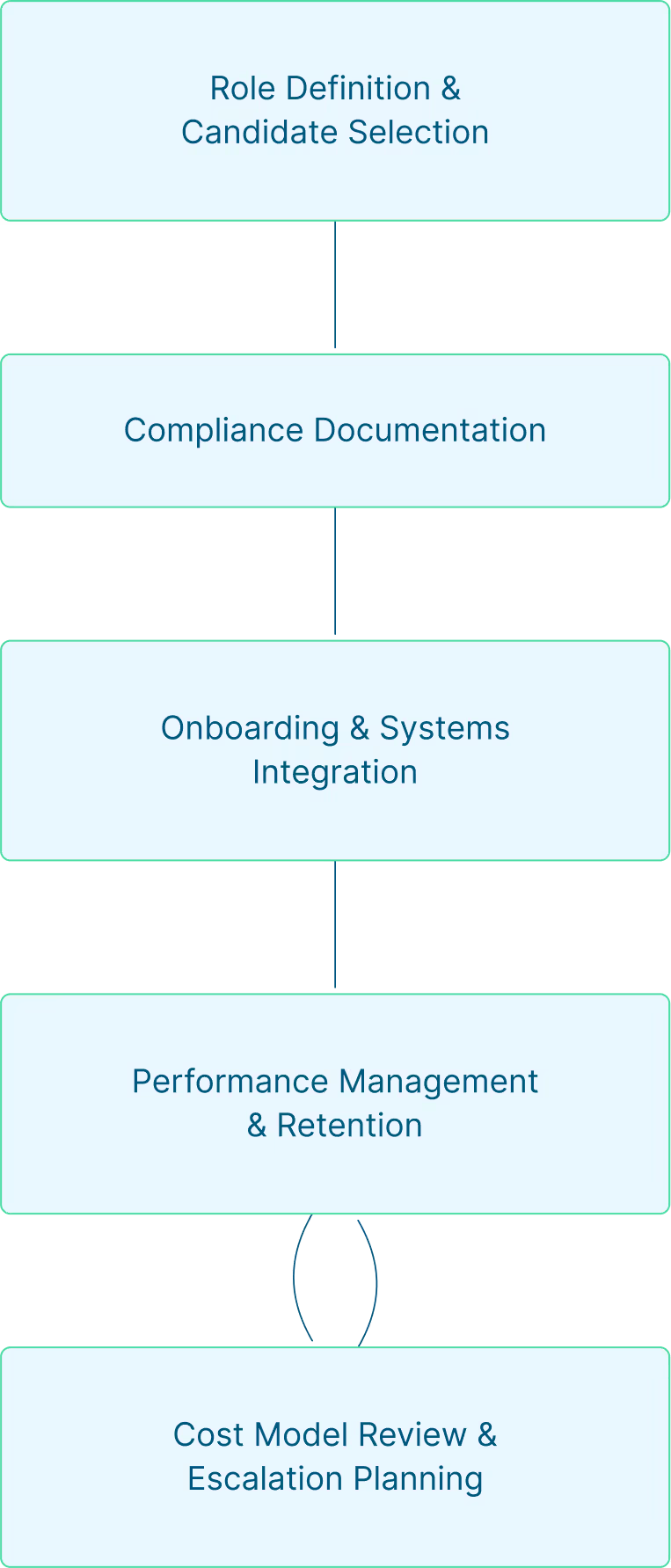
Phase 1: Candidate Selection and Role Definition
Role definition is the precondition for candidate quality. Firms that define roles too broadly — “we need an accountant” — without specifying the exact software stack, task types, and output standards the role requires produce candidate mismatches that surface only after onboarding investment has been made.
Mitigation: Build a role specification that mirrors your domestic job description — including software proficiency requirements, daily task breakdown, and clearly defined output standards for each deliverable.
Phase 2: Compliance Documentation
Data Processing Agreements (DPAs) and NPC-mandated PIP-PIC agreements are preconditions for data access, not administrative afterthoughts. Client data must not flow offshore before the legal framework is in place.
Mitigation: Execute all compliance documentation — DPA, NDA, IP assignment clauses — before provisioning any system access.
Phase 3: Onboarding and Systems Integration
Offshore staff who receive access credentials but no structured training on firm-specific workflows, client communication standards, or quality expectations stall in productivity. Frustration builds on both sides.
Mitigation: A documented 90-day onboarding plan with weekly milestones, a designated US-side point of contact, and explicit sign-off gates before the staff member takes on unsupervised work. A realistic expectation: 60–90 days of reduced productivity during integration is normal, not a failure signal.
Phase 4: Performance Management and Retention
After the initial onboarding period, offshore staff who receive no structured feedback, no career development conversation, and no visibility into how their work connects to firm outcomes will leave. Attrition follows predictably from neglect.
Mitigation: Semi-annual performance reviews, documented career progression pathways, and regular inclusion in firm communications and team meetings — even asynchronously.
Phase 5: Cost Model Review and Escalation Planning
Provider fees, technology costs, and statutory contribution increases erode the original savings projection over 18–24 months when the firm did not build escalation assumptions into its financial model.
Mitigation: Model total cost of engagement with annual escalation assumptions for Philippine salary levels and statutory contribution rates, based on observed market trends. Review the cost model annually.
IRS Circular 230 Supervision: The Mandatory Quality Gate
For US CPA firms using offshore staff in tax preparation or review workflows, IRS Circular 230 requires that a licensed CPA review and take professional responsibility for any work product prepared by a non-CPA offshore staff member before it is delivered to a client or filed with a tax authority. The offshore staff member can prepare, organize, and process — but the CPA’s supervisory review is the non-negotiable quality gate. Firms should maintain written supervisory protocols that can be produced in the event of a state board or IRS inquiry.
Key Benefits
Labor Cost Reallocation at Scale
The primary structural benefit is the reallocation of labor spend — moving support-level work to a lower-cost, high-quality talent market while freeing domestic capacity for higher-margin, client-facing, and licensed-professional work. This isn’t an abstract savings percentage. Run three to five support-level roles through the math at a typical $5–15M practice, and the gap between domestic cost and offshore engagement cost is often what separates a firm that’s profitable from one that’s structurally underwater.
Client Control Over Workflow and Performance
Unlike traditional outsourcing, remote staffing gives the client full visibility into individual performance. The client selects the candidate, sets the standards, integrates the staff member into internal systems, and manages output directly. This control is the source of the quality upside — and the reason the model requires more management investment than outsourcing.
Scalability Without Fixed Overhead
Remote staffing allows firms to add roles without the fixed overhead of domestic hiring cycles — office space, benefits administration, recruiting timelines. The provider absorbs the local employment infrastructure. The client scales headcount against workload, not against lease commitments.
Deep English Proficiency and Cultural Alignment
Philippine-based professionals working in accounting, administrative, and data-processing roles typically require materially less communication scaffolding than counterparts in other offshore markets. Cultural alignment with American business norms — deadline culture, hierarchical reporting structures, client-service orientation — reduces the management overhead of offshore integration.
Time-Zone Operability
The time-zone gap looks bigger on paper than it plays out in practice. Philippine staff shift their schedules to overlap with US business hours as a matter of course — real-time collaboration and same-day turnaround aren’t a special accommodation, they’re the default across the IT-BPM sector.
Cybersecurity Architecture Compatibility
US firms can integrate offshore staff into existing cloud-based accounting workflows using credential-based platform access — no VPN, no on-premises system exposure. Role-based permissions restrict each offshore staff member to their assigned client portfolio. Audit logs provide a real-time access record satisfying both internal policy and client due diligence requirements.
Costs & Pricing
The Base-Salary Trap: The Most Common Analytical Error
The base-salary comparison is the most common error in offshore staffing evaluation. Total cost of engagement is materially higher than base salary alone, and firms that model only the salary differential will find their projected savings compressed in year one.
Full-Cost Stack: What the Model Must Include
| Cost Component | Notes |
| Philippine base salary | Market-rate for role and experience level; rising annually |
| Statutory employer contributions | SSS, PhilHealth, Pag-IBIG — typically 12–15% above base salary |
| 13th month pay | Mandatory under Philippine law; equivalent to one month’s base salary |
| Provider management fee | Covers HR, payroll processing, compliance, and local administration |
| Technology and platform licensing | Cloud accounting software seats, security tools, communication platforms |
| Onboarding and training investment | Often underestimated; 60–90 days of reduced productivity is realistic |
| Compliance overhead | DPA execution, NPC-mandated PIP-PIC agreements, IP assignment documentation |
Statutory Contributions: Non-Negotiable Line Items
Philippine statutory employer contributions — SSS, PhilHealth, and Pag-IBIG — add approximately 12–15% above base salary to the total employment cost for locally hired staff. These are non-negotiable. Any provider quoting a total engagement cost that does not account for these contributions is either absorbing them in their margin or presenting an incomplete cost model.
The TRAIN Law and Net Pay Expectations
The TRAIN Law (Republic Act 10963) restructured Philippine personal income tax brackets, increasing net take-home pay for employees across most salary bands. The practical effect for US firms: Philippine-based professionals now have higher net compensation expectations relative to gross salary offers. Benchmarking gross salary offers without accounting for the TRAIN Law’s impact on net pay can result in offers that appear competitive on paper but underperform against local market alternatives.
Salary Benchmarking Is a Live Exercise
BPO firms, multinational shared service centers, and domestic Philippine employers all compete for the same graduate pool. Compensation expectations have risen materially over the past decade. A firm entering the market today with outdated salary assumptions will lose candidates to better-structured offers before the first interview concludes.
Cost Model Drift Over 18–24 Months
Provider fees, technology costs, and statutory contribution increases erode the original savings projection over time when escalation assumptions are not built into the financial model. Model the total cost of engagement with annual escalation assumptions for Philippine salary levels and statutory contribution rates, based on observed market trends. Review the cost model annually.
Global Case Studies
Anonymized composite case studies based on engagements with US-based professional services firms. No real firm names, headcounts, or financials are attributed.
Composite A: Labor Cost Reallocation in a Mid-Market Accounting Practice
A US-based accounting practice in the $5–15M revenue band transitioned two bookkeeping roles and one payroll processing role offshore. The managing partner noted that the blended labor cost per role declined materially while client-facing turnaround commitments were maintained — and that the savings funded two additional client-facing hires domestically, representing a structural reallocation rather than a simple cost cut.
The critical variable: the firm modeled the full cost stack — including statutory contributions, provider management fees, technology licensing, and compliance overhead — before committing. The engagement remained net-positive in year one, though the timeline to breakeven extended beyond the initial projection because early-stage compliance and onboarding costs had been underestimated.
Composite B: Phased Expansion in a Regional Tax and Advisory Firm
An anonymized composite of a regional tax and advisory firm piloted offshore staffing for administrative and data-entry functions before expanding to supervised tax preparation support. The phased structure allowed the firm to build supervisory workflows and test quality controls before increasing the complexity of offshore-handled work. IRS Circular 230 supervisory review protocols were documented before any return preparation work was assigned to offshore staff.
Composite C: Attrition Recovery Through Structured Onboarding
A mid-market CPA firm we advised experienced above-average first-year attrition among offshore staff, traced to two root causes: insufficient onboarding structure in the first 30 days, and no visible career progression pathway beyond the initial role. After implementing a structured 90-day integration protocol — including weekly check-ins with a US-side supervisor, documented role expectations, and a semi-annual performance review cycle — retention improved materially in year two. The structural interventions were process-intensive, not expensive.
Composite D: Cybersecurity Architecture for Cloud-Based Workflows
One firm’s biggest worry going in was security — handing offshore staff any kind of system access felt like a real exposure. What they landed on solved it without adding infrastructure: staff logged into the firm’s existing cloud accounting platform directly, credential by credential, with no VPN and nothing touching an on-premises server. Each person’s permissions were scoped tightly to the specific client accounts they worked on, and every login and action left a timestamped trail in the platform’s audit log. When a client’s own IT team asked for proof of access controls during a routine vendor review, the firm pulled the log and answered the question in an afternoon.
Composite E: Compliance Documentation as a Precondition
A composite professional services operator that omitted provider management fees, technology licensing, and compliance overhead from its initial ROI model found its projected savings compressed significantly in year one. Separately, a firm that treated DPA execution as an administrative afterthought provisioned system access before the legal framework was in place — creating a contractual and regulatory exposure that required retroactive remediation. Both cases resolved — but at a cost in time and legal overhead that the original model had not anticipated.
Philippines Relevance & Local Examples
Why the Philippines Has Absorbed a Disproportionate Share of Offshore Demand
The Philippines’ position as a leading remote staffing hub is structural, not accidental. Several reinforcing factors explain the concentration of US professional services demand in this market.
English Proficiency and Communication Fit
The Philippines consistently ranks among the highest-rated Asian nations for English proficiency across widely observed industry assessments. For roles involving client communication, document review, or real-time collaboration with US-based partners, communication friction is a direct cost — in rework, in supervision time, in client relationship risk. Philippine-based professionals in accounting, administrative, and data-processing roles typically require materially less communication scaffolding than counterparts in other offshore markets.
Cultural Alignment With American Business Norms
Decades of IT-BPM industry development, combined with a US-influenced educational system, have produced a workforce that understands deadline culture, hierarchical reporting structures, and client-service orientation. This alignment reduces the management overhead of offshore integration in ways that are difficult to quantify but are consistently noted by US firms that have operated in multiple offshore markets.
Workforce Scale and IT-BPM Infrastructure
The Philippine Statistics Authority tracks the IT-BPM sector as one of the country’s largest employers, with a workforce numbering in the hundreds of thousands and growing year-over-year. The infrastructure built around this sector — fiber connectivity, purpose-built office campuses, PEZA-registered economic zones with fiscal incentives for registered operators — creates a supply-side ecosystem that smaller offshore markets cannot replicate.
For US firms, this competitive landscape has a practical consequence covered in the pricing section below: what counted as a strong offer two or three years ago may no longer clear the bar.
Philippine Statutory Framework: What US Firms Must Understand
DOLE and Labor Law: Philippine DOLE regulations govern mandatory benefits, termination procedures, and labor standards. When a US firm engages a remote staffing provider, the provider is the legal employer of record. DOLE obligations — including mandatory benefits, notice periods, and separation pay calculations — fall on the provider. The US client firm is insulated from direct Philippine labor liability, provided the provider relationship is properly structured. Terminating an offshore employee without proper cause and process can trigger statutory separation pay obligations. US firms accustomed to at-will employment norms must understand that Philippine labor law operates differently.
Statutory Contributions: SSS, PhilHealth, and Pag-IBIG contributions add approximately 12–15% above base salary to the total employment cost for locally hired staff. These are non-negotiable line items.
13th Month Pay: Mandatory under Philippine law; equivalent to one month’s base salary. Must be included in any full-cost model.
The TRAIN Law: Republic Act 10963 restructured Philippine personal income tax brackets, increasing net take-home pay across most salary bands. Benchmarking gross salary offers without accounting for the TRAIN Law’s impact on net pay can result in offers that underperform against local market alternatives.
The Philippine Data Privacy Act (RA 10173): Offshore staffing arrangements involving access to personal data — client financial records, employee information, tax data — require properly executed Data Processing Agreements and, where applicable, NPC-mandated PIP-PIC agreements governing cross-border data flows. The National Privacy Commission has enforcement authority. This is not optional compliance.
PEZA and the CREATE Act: Providers operating under PEZA registration with CREATE Act (Republic Act 11534) incentives may carry a lower cost structure, translating into more competitive management fee pricing. PEZA registration is also a useful signal of operational maturity and compliance standing.
Time-Zone Operability
The Philippines operates at UTC+8. The raw gap with US Eastern business hours is 12–13 hours — which sounds prohibitive until you account for shift scheduling. Philippine-based remote staff routinely work US daytime hours, enabling real-time collaboration and same-day turnaround on deliverables. This is standard operating practice across the IT-BPM sector.
Comparison Table
The table below maps the three primary staffing models across the dimensions most relevant to US professional services firms evaluating offshore expansion.
| Dimension | Remote Staffing (Offshore) | Traditional Outsourcing | Domestic Hiring |
| Client control over workflow | High — client directs daily work | Low — vendor manages delivery | Full |
| Visibility into individual performance | High | Low to none | Full |
| Labor cost structure | Lower base + statutory load + provider fee | Output-based pricing | Highest fully loaded cost |
| Compliance obligations | Shared (provider = employer of record) | Vendor-owned | Client-owned |
| Onboarding investment | Moderate — firm-specific training required | Low | High |
| Attrition risk | Moderate — manageable with structure | Vendor-absorbed | Client-absorbed |
| Data privacy framework | DPA + NPC PIP-PIC agreements required | Vendor-managed | Domestic law applies |
| Scalability | High — add roles without fixed overhead | Moderate | Low — hiring cycle friction |
| Cultural/communication fit | High (Philippines) | Variable by market | Highest |
| IP and confidentiality enforcement | Contractual (NDA + DPA layer) | Contractual | Domestic legal framework |
Reading the Table
Remote staffing occupies the middle position on control and compliance complexity — higher client involvement than outsourcing, lower fixed overhead than domestic hiring. The model’s value proposition is strongest for firms that can invest in onboarding and performance management infrastructure, and weakest for firms that want vendor-style hands-off delivery without the management commitment that embedded offshore staff requires.
The compliance column is the most important differentiator for US accounting firms specifically. Remote staffing requires the client to actively manage the data privacy and supervisory compliance layer — DPAs, NPC agreements, IRS Circular 230 supervisory protocols — rather than delegating it to a vendor. That obligation is the price of the control advantage.
Conclusion & Actionable Takeaway
Remote staffing from the Philippines is not a cost-cutting tactic. Executed correctly, it is a structural reallocation of labor spend — moving support-level work to a lower-cost, high-quality talent market while freeing domestic capacity for higher-margin, client-facing, and licensed-professional work.
The firms that extract durable value from offshore staffing share three operational characteristics: they model the full cost stack before committing, they invest in onboarding and retention infrastructure from day one, and they treat compliance — Philippine labor law, NPC data privacy requirements, IRS Circular 230 supervision standards — as a precondition rather than an afterthought.
The firms that struggle treat offshore staffing as a procurement decision rather than a people management decision. They optimize for the lowest provider fee, skip the compliance documentation, and then attribute the resulting attrition and quality problems to “offshore staffing” as a category — when the failure was in execution, not in the model.
The market conditions that make this model attractive — US wage inflation, Philippine talent depth, cloud-based workflow integration — are structural, not cyclical. Firms that build the operational capability to manage offshore teams effectively now will carry a durable cost and capacity advantage over those that wait.
Start with a defined role, a full-cost model, and a compliance-first onboarding structure. Expand from there. If you’re ready to see what that looks like in practice, OffshorePH structures these engagements for US professional services firms end to end — from candidate selection through the compliance layer.
FAQs
Can a US CPA firm legally use Philippine-based staff to prepare tax returns, and what supervision structure is required?
Yes — but IRS Circular 230 requires that a licensed CPA review and take professional responsibility for any return prepared by a non-CPA offshore staff member before filing or client delivery. The offshore staff member can handle data entry, workpaper preparation, and initial return assembly; the CPA’s documented supervisory review is the mandatory quality gate. Firms should maintain written supervisory protocols that can be produced in the event of a state board or IRS inquiry.
What specific agreements are required under Philippine law before offshore staff can access US client financial data?
At minimum: a Data Processing Agreement (DPA) executed between the Philippine-based staffing provider (as Personal Information Processor) and the US firm (as Personal Information Controller), consistent with the requirements of the Philippine Data Privacy Act of 2012 (Republic Act 10173) and NPC advisory guidance on cross-border data transfers. Where the arrangement involves sub-processing or data sharing between entities, NPC-mandated PIP-PIC agreements may also be required. These documents must be in place before any personal data is transmitted or accessed.
How should a US firm handle termination of an offshore remote staff member if performance standards are not met?
Termination of a Philippine-based employee is governed by DOLE regulations, not US at-will employment norms. The staffing provider, as employer of record, manages the termination process — but the US client firm must provide documented performance evidence and follow the provider’s established HR protocols. Terminations without documented cause and proper notice can trigger statutory separation pay obligations under Philippine labor law. Firms should establish clear performance documentation practices from the start of the engagement, not retroactively when a termination decision is being made.
What cybersecurity baseline should a US firm require from an offshore staffing provider before provisioning access to client accounting systems?
The operational minimum: SOC 2 Type II certification or a documented equivalent control framework, multi-factor authentication on all platform access, role-based permission structures limiting each staff member to their assigned client scope, and audit log retention covering all data access events. For providers that cannot demonstrate SOC 2 certification, the US firm should implement compensating controls at the platform level — restricting access through the cloud accounting software’s native permission architecture rather than relying on the provider’s infrastructure security alone.
Related Services & Next Steps
Ready to move from evaluation to implementation? The resources below map to the operational sequence described in this article.
