
A dedicated offshore QA team is a structured group of quality assurance engineers — hired, managed, and embedded in a client’s sprint cadence from a lower-cost geography — who operate as a permanent extension of the client’s engineering organization rather than as a project-based vendor. Unlike outsourced QA contracts, dedicated teams use the client’s toolchain, report to the client’s engineering leadership, and carry ongoing accountability for defect escape rates across release cycles.

The Structural Problem Dedicated QA Solves
Release velocity is not primarily a development problem. It is a testing throughput problem.
Most software engineering organizations can write code faster than they can validate it. When QA is understaffed, under-tooled, or structurally disconnected from the sprint cycle, the result is predictable: release candidates queue up, regression cycles stretch across days, and engineering leadership faces a binary choice between shipping with unknown risk or delaying with known cost.
Hiring onshore QA engineers to close that gap is expensive and slow. In the United States, QA engineer compensation — including base salary, employer payroll taxes, benefits, and recruiting overhead — can represent a substantial annual cost per head. The gap between that figure and an equivalent fully-loaded offshore role in the Philippines is operationally significant.
Dedicated offshore QA teams — specifically those structured as embedded squad members rather than ticket-takers — address the throughput constraint without requiring the capital commitment of onshore headcount expansion.
The Dedicated vs. Project-Based Distinction
The primary failure mode in offshore QA is not technical competence. It is structural disconnection. Teams that operate outside the sprint cadence, use different defect severity definitions than the onshore team, or lack direct access to the engineering lead produce noise rather than signal.
A dedicated offshore QA team resolves this by embedding accountability directly into the client’s engineering structure: the team attends sprint planning, standups, and retrospectives; uses the client’s toolchain; and maintains continuous domain knowledge rather than resetting at project end.
Engagement Models
CTOs evaluating offshore QA staffing typically encounter four distinct engagement architectures:
Pure Manual QA — Best for early-stage products with rapidly changing UI or business logic where automation investment would be premature. A 2–3 person manual QA team can cover exploratory testing, regression checklists, and UAT support within sprint cycles.
Automation-First QA — Teams built around Selenium, Cypress, or Playwright frameworks. The initial investment is front-loaded — typically 6–12 weeks to build baseline test suites — but the ongoing cost per regression cycle drops materially once the suite is established. Best for products with stable UI patterns and high release frequency.
Performance and Load Testing — Specialist teams using k6, JMeter, or Gatling to validate system behavior under load. Typically deployed as a component of a larger QA function rather than as a standalone team. Critical for SaaS products with variable traffic patterns or fintech platforms with transaction throughput requirements.
Hybrid Model — The most common configuration in mature offshore QA engagements: a core automation engineer maintaining and extending the test suite, one or two manual QA engineers covering exploratory and regression testing, and periodic performance testing cycles. Scales with the product’s complexity.
The Onboarding Ramp: Where Most Engagements Succeed or Fail
The 4–8 week onboarding period is the highest-risk phase of any offshore QA engagement. Teams that compress or skip it consistently underperform.
| Week | Milestone |
| 1–2 | Environment access provisioning; toolchain orientation; product domain walkthrough with engineering lead |
| 2–3 | Defect severity taxonomy alignment; test case template standardization; first sprint participation (observer role) |
| 3–5 | Baseline test suite documentation; first independent regression cycle; defect reporting calibration |
| 5–7 | Automation framework setup (if applicable); CI/CD pipeline integration; KPI baseline established |
| 7–8 | Full sprint ownership; defect escape rate tracking begins; retrospective participation active |
Teams that skip the taxonomy alignment step — agreeing on what constitutes a P1 versus P2 versus P3 defect — generate friction for months afterward. A defect that the offshore team classifies as low-severity and the onshore team treats as a blocker creates trust erosion that is difficult to recover from.
KPIs That Actually Measure Offshore QA Performance
Vanity metrics — test cases written, test cases executed — tell CTOs almost nothing about QA team effectiveness. The metrics that matter:
Defect Escape Rate — The percentage of bugs reaching production that were not caught in QA. This is the single most operationally meaningful quality metric. A well-functioning dedicated offshore QA team should drive this number down measurably within two to three sprint cycles of full operation.
Regression Cycle Duration — How long does a full regression suite take to execute and produce results? In follow-the-sun models, this should compress to under 8 hours for well-structured automated suites.
Defect Detection Rate by Phase — What percentage of defects are caught in QA versus UAT versus production? Shift-left QA models should show increasing detection earlier in the cycle over time.
Test Coverage Metrics — Code coverage percentage and test-to-code ratio are trackable in CI/CD pipelines regardless of team geography. These provide an objective measure of automation suite maturity.
Defect Logging Turnaround — How quickly does the offshore team log a defect after detection? Delays in defect logging create downstream scheduling risk.

How It Works
The Follow-the-Sun QA Workflow
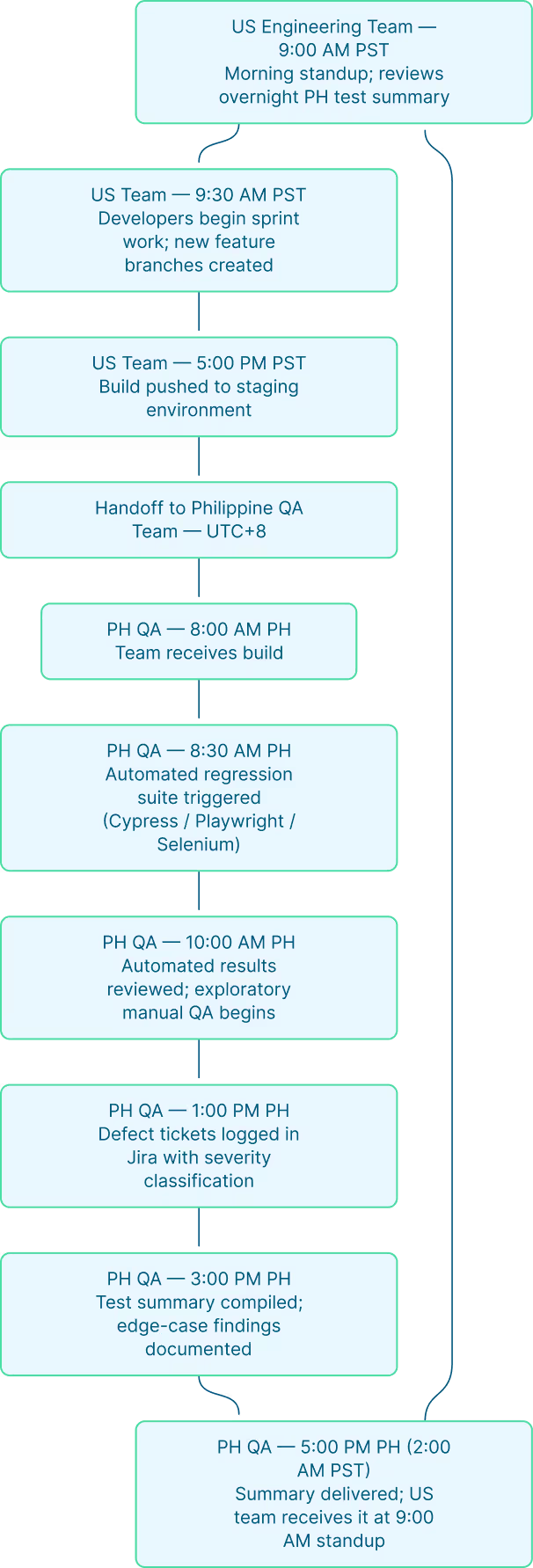
The time-zone architecture between the Philippines (UTC+8) and the US West Coast (UTC−7/−8) is not a liability. It is a follow-the-sun asset. Philippine QA engineers execute overnight regression suites against the prior day’s build and deliver structured test summaries before the US team’s morning standup. The feedback loop on regression testing, which can stretch to 24–48 hours in single-timezone teams, compresses to under 8 hours in well-structured engagements.
Follow-the-Sun QA Handoff Cycle
 ;/.,
Sprint Integration: How the Team Embeds
This architecture eliminates the single-timezone bottleneck where QA and development compete for the same working hours. The US team ships code; the Philippine team validates it overnight; the US team wakes to a structured defect summary. Release candidates move faster because the validation cycle no longer sits idle.
The offshore team participates in sprint planning, standups, and retrospectives — not as observers but as accountable squad members. They own defect severity classification, maintain the test suite, and carry continuous domain knowledge across release cycles.
Vendor Evaluation: What to Assess Before Engaging
When evaluating offshore QA staffing partners, assess against these five dimensions:
| Evaluation Dimension | What to Probe |
| Toolchain compatibility | Does the team have demonstrated experience with your specific stack? (Cypress vs. Selenium vs. Playwright are not interchangeable skill sets) |
| English communication proficiency | Review sample defect write-ups and assess verbal standup participation directly — not just a recruiter’s assessment |
| Tech stack experience | Request evidence of prior work on comparable product architectures |
| Data security posture | ISO 27001 certification, SOC 2 readiness, VDI capability, NDA structure |
| Attrition guarantees and replacement SLAs | What is the contractual commitment if a team member exits? What is the replacement timeline? |

Key Benefits
Throughput Without Onshore Capital Commitment
Dedicated offshore QA teams address the testing throughput constraint without requiring the capital commitment of onshore headcount expansion. The US team ships code; the Philippine team validates it overnight; the US team wakes to a structured defect summary.
Follow-the-Sun Compression of Regression Cycles
The time-zone gap between the Philippines and the US West Coast — roughly 15 to 16 hours — enables genuine follow-the-sun testing. Regression cycles that stretch 24–48 hours in single-timezone teams compress to under 8 hours in well-structured offshore engagements.
Accumulated Domain Knowledge
Unlike project-based arrangements where team composition resets at engagement end, dedicated offshore QA teams accumulate continuous domain knowledge. Defect taxonomy alignment is established once and maintained permanently. Ramp cost is paid once rather than repeatedly.
Shift-Left Quality Improvement
When offshore QA engineers participate in story refinement sessions — flagging ambiguous acceptance criteria and edge cases before a line of code is written — the volume of defects reaching UAT drops meaningfully. The cost of defect remediation falls because defects are caught earlier, when the fix cost is lower.
Predictable Fixed Monthly Cost
Dedicated models carry a fixed monthly headcount cost rather than the variable, scope-driven billing of project-based arrangements. This enables accurate engineering budget forecasting across quarters.
Structural Redundancy at Minimum Team Size
A three-engineer team — typically one automation engineer and two manual/exploratory QA — provides the minimum redundancy for continuous sprint coverage. Teams of five or more can support hybrid models with performance testing capacity.

Costs & Pricing
The Real Cost Structure: What CTOs Actually Pay
Philippine statutory employment costs are governed by four mandatory obligations:
- SSS (Social Security System) — governed by Republic Act No. 8282
- PhilHealth — premium contribution schedules updated periodically
- Pag-IBIG (Home Development Mutual Fund) — mandatory employer contributions
- 13th-Month Pay — Presidential Decree No. 851, equivalent to one month’s base salary annually
The statutory benefits load in the Philippines is generally estimated at 12–15% above base salary when these four obligations are aggregated. This is a hardcoded floor — not a negotiable variable — and any offshore staffing cost model that omits it is structurally incomplete.
Fully-Loaded Cost Components
Beyond statutory costs, a fully-loaded offshore QA headcount cost includes:
- Base salary
- Statutory benefits (estimated 12–15% above base)
- Infrastructure (VPN, VDI, software licenses)
- Management overhead
- Staffing partner margin (in managed dedicated team models)
Even with all of those components included, the total employer cost for a mid-level QA automation engineer in Metro Manila or Cebu typically sits at a meaningful discount to the equivalent US-based role. Publicly available US compensation data for software quality assurance engineers can be used as a role-equivalency benchmark when building a cost comparison model.
The Cost Ceiling and Floor
The ceiling: A 3–5 person dedicated offshore QA team can deliver testing throughput equivalent to a larger onshore team at a fraction of the fully-loaded annual cost.
The floor: That cost advantage erodes if attrition is high, onboarding is unstructured, or the team operates without direct access to engineering leadership. Year-one attrition in poorly structured offshore QA arrangements can be meaningful; dedicated models with documented career pathing and compensation review cycles perform materially better.
Automation Investment Timing
For automation-first QA engagements, the initial investment is front-loaded — typically 6–12 weeks to build baseline test suites — but the ongoing cost per regression cycle drops materially once the suite is established. Pure manual QA carries lower tooling cost but higher per-test-cycle labor cost at scale.

Global Case Studies
Anonymized composite case studies based on typical engagement patterns observed across offshore QA staffing engagements. No real named company incidents or metrics are fabricated or attributed.
Composite A: Series A SaaS Startup, 15–40 Engineers
A US-based SaaS startup with a 20-person engineering team was shipping releases every three to four weeks. The bottleneck was not development velocity — it was regression testing, which consumed two to three days of a single onshore QA engineer’s time per release candidate.
The CTO embedded a dedicated 3-person offshore QA team in the Philippines into the existing two-week sprint cycle. After a 6-week onboarding ramp, the team was executing nightly automated regression suites using Cypress against the staging environment. Consolidated test summaries were ready before the US team’s 9 AM standup. Release candidates that previously required a multi-day validation window were cleared overnight. The defect escape rate dropped measurably within the first quarter of full operation.
The structural change was not the offshore location. It was the sprint embedding. The team attended planning sessions, contributed to retrospectives, and owned defect severity classification. They were not a vendor. They were a squad.
Composite B: B2B Fintech, Shift-Left Implementation
A B2B fintech software company’s CTO inherited a QA function that operated exclusively at the end of the development cycle — reviewing completed features against acceptance criteria. Defects caught at that stage were expensive to remediate: code had already been reviewed, merged, and integrated.
The CTO restructured the offshore QA team’s involvement to begin at requirements review. QA engineers participated in story refinement sessions, flagging ambiguous acceptance criteria and edge cases before a line of code was written. Over two quarters, the volume of defects reaching UAT dropped meaningfully. The cost of defect remediation fell because defects were caught earlier, when the fix cost was lower.
The shift-left model requires QA engineers with strong domain comprehension and communication skills — not just test execution capability. Selecting for those attributes during hiring is the critical variable.
Composite C: Digital Agency, QA Pool Model
A digital agency managing 8–12 concurrent client product builds faced a recurring problem: QA demand was uneven across projects. Some weeks, three projects needed simultaneous regression cycles. Other weeks, the pipeline was light.
The agency structured a dedicated offshore QA pool — a fixed headcount block of 6 QA engineers managed as a dedicated team but allocated dynamically across projects based on sprint schedules. This absorbed testing demand spikes without onshore contractor hiring. The fixed monthly cost was predictable; the capacity was flexible within the pool.
The operational risk in this model is context-switching overhead. QA engineers moving between client codebases need structured handoff documentation. Without it, defect detection quality degrades at the edges of each project context.

Philippines Relevance & Local Examples
Why the Philippines, Specifically
The Philippines is not simply a low-cost labor market. It is a structurally differentiated QA talent pool. Three factors separate Metro Manila and Cebu from competing offshore destinations for software QA work.
English-Medium Technical Education
Philippine universities deliver IT and computer science curricula in English. The pipeline of IT graduates entering the workforce annually is substantial. For QA roles requiring precise defect documentation, test case authorship, and daily written communication with US or Australian engineering teams, English fluency is not a soft preference — it is a hard operational requirement.
Cultural Alignment with Western Agile Norms
Philippine software professionals have worked within US-aligned development cultures for over two decades through the IT-BPM sector. Sprint ceremonies, Jira workflows, pull request review culture, and asynchronous communication norms are not foreign concepts requiring acculturation. They are standard operating procedure.
Time-Zone Architecture as a Follow-the-Sun Asset
The Philippines operates at UTC+8. The US West Coast runs at UTC−7 or UTC−8 depending on daylight saving. That gap — roughly 15 to 16 hours — is not a liability. Philippine QA engineers can execute overnight regression suites against the prior day’s build and deliver structured test summaries before the US team’s morning standup.
Statutory Compliance and Data Privacy Framework
Philippine statutory employment costs are governed by SSS (Republic Act No. 8282), PhilHealth, Pag-IBIG, and 13th-Month Pay (Presidential Decree No. 851). The statutory benefits load is generally estimated at 12–15% above base salary — a transparent, governable floor.
On data privacy, the Data Privacy Act of 2012 (Republic Act No. 10173) establishes the Philippine legal framework for personal data processing. Organizations acting as Personal Information Controllers (PICs) must execute Data Processing Agreements (DPAs) with Personal Information Processors (PIPs) — the legal classification that applies to an offshore QA team handling client application data. NPC advisories clarify the specific requirements for these PIP-PIC agreements.
Security-conscious CTOs in regulated industries typically require:
- VPN-controlled access to all client environments; no direct internet routing of test traffic
- Virtual Desktop Infrastructure (VDI) with non-persistent sessions — no local data storage on offshore endpoints
- NDA and IP assignment agreements with dual-jurisdiction clauses
- ISO 27001 certification or SOC 2 readiness from the staffing partner
- Role-based access controls limiting QA team access to test environments only, with production data masked or anonymized where possible
A healthcare SaaS vendor operating in a HIPAA-adjacent environment, for example, can structure an offshore QA engagement where engineers operate exclusively within a VDI environment with zero local data persistence — full sprint participation, zero data residency risk. This is not a theoretical architecture. It is a standard configuration for regulated-industry offshore QA.
Review the compliance and service structures guide for how this is implemented in practice.
Comparison Table
| Dimension | Project-Based / Staff-Aug QA | Dedicated Offshore QA Team |
| Accountability structure | Vendor-managed; reports to outsourcer PM | Client-managed; reports to client’s engineering lead |
| Toolchain | Vendor’s preferred tools | Client’s toolchain (Jira, TestRail, Zephyr, Cypress, Playwright, etc.) |
| Sprint integration | Ad-hoc or milestone-based | Embedded in two-week sprint cycle; attends planning, standups, retros |
| Domain knowledge | Resets at project end | Accumulates continuously |
| Defect taxonomy alignment | Negotiated per engagement | Established once, maintained permanently |
| Attrition impact | High; team composition shifts per project | Lower in structured dedicated models with career pathing |
| Ramp cost | Paid repeatedly | Paid once (4–8 week initial ramp) |
| Cost predictability | Variable; scope-driven | Fixed monthly headcount cost |
Conclusion & Actionable Takeaway
Dedicated offshore QA is not a cost-cutting tactic. It is a throughput architecture decision.
CTOs who treat it as a budget line item — hiring the cheapest available QA resource offshore and expecting results — consistently underperform relative to those who treat it as a structural engineering decision: selecting for domain-compatible skills, investing in a real onboarding ramp, embedding the team in sprint ceremonies, and tracking defect escape rate as the primary performance signal.
The Philippines offers a structurally differentiated talent pool for this function: English-proficient, agile-native, operating in a time zone that enables genuine follow-the-sun testing cycles. The statutory cost structure is transparent and governable. The compliance framework — NPC-mandated PIP-PIC agreements under the Data Privacy Act of 2012 — is mature enough to satisfy regulated-industry requirements when implemented correctly.
The organizations that extract the most value from dedicated offshore QA are those that treat the offshore team as an engineering squad, not a service ticket. That distinction — embedded accountability versus transactional delivery — is what separates the CTOs who ship faster from those who simply spend less.
If your release cycle is constrained by testing throughput, the question is not whether offshore QA can solve it. The question is whether your onboarding structure, toolchain access, and sprint integration are ready to make it work.
Explore how OffshorePH structures dedicated offshore QA teams →
Review our compliance framework for regulated-industry offshore staffing →
FAQs
How do we handle IP ownership when offshore QA engineers write automation scripts and test frameworks on our codebase?
IP ownership must be explicitly assigned in the employment or services agreement — it does not transfer automatically under Philippine law. The standard mechanism is a dual-jurisdiction IP assignment clause: Philippine law governs the employment relationship; the client’s jurisdiction (typically US or Australian law) governs IP ownership of all work product created during the engagement. Any offshore QA staffing agreement that lacks an explicit work-for-hire or IP assignment provision leaves ownership ambiguous. Resolve this before the first line of test code is written.
Can an offshore QA team in the Philippines legally handle HIPAA-regulated data or PII from US healthcare applications?
Philippine law does not prohibit offshore teams from handling US-regulated data, but it imposes its own compliance layer. Under the Data Privacy Act of 2012, the offshore team operates as a Personal Information Processor (PIP) and must execute a Data Processing Agreement (DPA) with the US entity acting as the Personal Information Controller (PIC), compliant with NPC requirements. For HIPAA-adjacent environments, the technical architecture — VDI with non-persistent sessions, masked production data in test environments, role-based access controls — carries more operational weight than the legal agreement alone. Both layers are required.
What is the realistic minimum team size for a dedicated offshore QA engagement to be operationally viable?
Two engineers is the practical floor, and it carries meaningful single-point-of-failure risk. If one engineer is unavailable, QA throughput halves. Three engineers — typically structured as one automation engineer and two manual/exploratory QA — provide the minimum redundancy for continuous sprint coverage. Teams of five or more can support hybrid models with performance testing capacity. For early-stage products with low release frequency, a two-person team can be viable if the staffing agreement includes a defined replacement SLA.
How should we structure the defect severity taxonomy alignment during onboarding to avoid classification disputes later?
Run a calibration exercise in week two of onboarding: take 10–15 real defects from your historical backlog — spanning the full severity range — and have the offshore team classify them independently before comparing against your onshore team’s classifications. Divergences reveal taxonomy gaps. Document the agreed definitions in a shared reference document in your wiki or Confluence, linked directly from the Jira project. Revisit the taxonomy at the first retrospective after the team reaches full sprint participation. Disputes that surface after three months of operation are almost always traceable to a calibration step that was skipped or rushed.
Related Services & Next Steps
Dedicated Offshore QA Teams
If your release cycle is constrained by testing throughput, a dedicated offshore QA team embedded in your sprint cadence is the structural solution.
Compliance Framework for Regulated Industries
For fintech, healthcare SaaS, and legal tech CTOs operating in HIPAA-adjacent or PII-sensitive environments, the compliance architecture — VDI, NPC-compliant DPAs, role-based access controls — is a prerequisite, not an afterthought. Review the compliance framework →
Onboarding Checklist
The 4–8 week onboarding ramp is where most offshore QA engagements succeed or fail. A structured checklist covering environment provisioning, taxonomy alignment, and CI/CD integration reduces ramp risk materially. Access the onboarding checklist →
Pricing Structures for Dedicated QA Headcount
Fully-loaded offshore QA headcount cost includes base salary, statutory benefits (estimated 12–15% above base), infrastructure, management overhead, and staffing partner margin.
